Quick Answer: Should you build or buy AI marketing agents?
Build AI marketing agents when you need a small experiment or a distinctive workflow that your team can support. Buy when an existing solution fits the job and you need outside help to run it reliably. If a prototype becomes essential, give it a technical owner and a marketing owner before more people depend on it. Compare the full cost of ownership, test real work, and keep a person responsible for business decisions.
I built a Meta Ads agent to make my own work easier. I had never written code before. Then my CMO began asking the agent questions instead of asking me.
What started as a personal tool soon needed more than a useful answer. It needed to stay available, use the right accounts and apply our team’s marketing knowledge. Our engineers later built the production version.
That experience shaped my original LinkedIn article on building or buying an agent. This guide expands the decision with a comparison, a cost worksheet and a pilot plan you can use with your team.
What are you actually building or buying?
Before comparing AI marketing agents, define the work you want done. A tool that summarizes ad reports is a different purchase from one that can change campaign budgets.
For this guide, an agent uses a model, business context and connected tools to carry out a marketing task within agreed limits. It may investigate a problem, prepare a recommendation or take an approved action.
However, some jobs only need a fixed rule. If you want an alert whenever spend exceeds a set amount, ordinary automation may be enough. An agent becomes more useful when it must review several signals and decide what to check next.
Anthropic’s guidance on building effective agents recommends starting with the simplest approach that meets the need. Apply that principle before you choose a vendor or start a build.
Buy a platform
You get tools for creating workflows. Your team may still need to design the process, connect data and maintain the agent.
Buy a ready-made agent
You get a product for a defined task. Check how much setup, business context and ongoing review it needs from you.
Buy a managed solution
A provider may help build, deploy and operate the system. The scope of that support matters as much as the software.
Therefore, compare actual responsibilities. Two products called an “AI marketing agent” may leave very different amounts of work with your team.
Three problems that appear after the prototype works
The difficult part often begins when other people trust the tool. At that point, AI marketing agents become part of how the business makes decisions.
People rely on answers nobody has checked
A plausible explanation can travel from an informal chat into a budget meeting. For example, an agent may call a campaign successful because cost per lead fell. Yet the new leads might never become qualified opportunities.
First, define what a good answer must include. That might mean a date range, the source data, the relevant conversion event and a clear statement of uncertainty. Then check its answers against work your marketers already understand.
The system depends on one person
Ask what happens when the builder goes on vacation. Can someone else pay the bill, restore access, understand a failure and stop a bad action?
If the answer is no, the company has a continuity problem. Move approved access into company-managed accounts, document the setup and name a backup owner. Also make sure someone notices failures before the next planning meeting.
It lacks the context behind your decisions
Marketing judgment includes details that a dashboard cannot explain. A new campaign may need time to learn. A promotion may lower margin. A cheap lead may come from the wrong market.
Therefore, an agent needs your acquisition goals, qualified-lead rules, margins, sales cycle and campaign history. Give each source an owner who can keep it current. More connected data does not automatically mean better judgment.
AI marketing agents: compare three ownership options
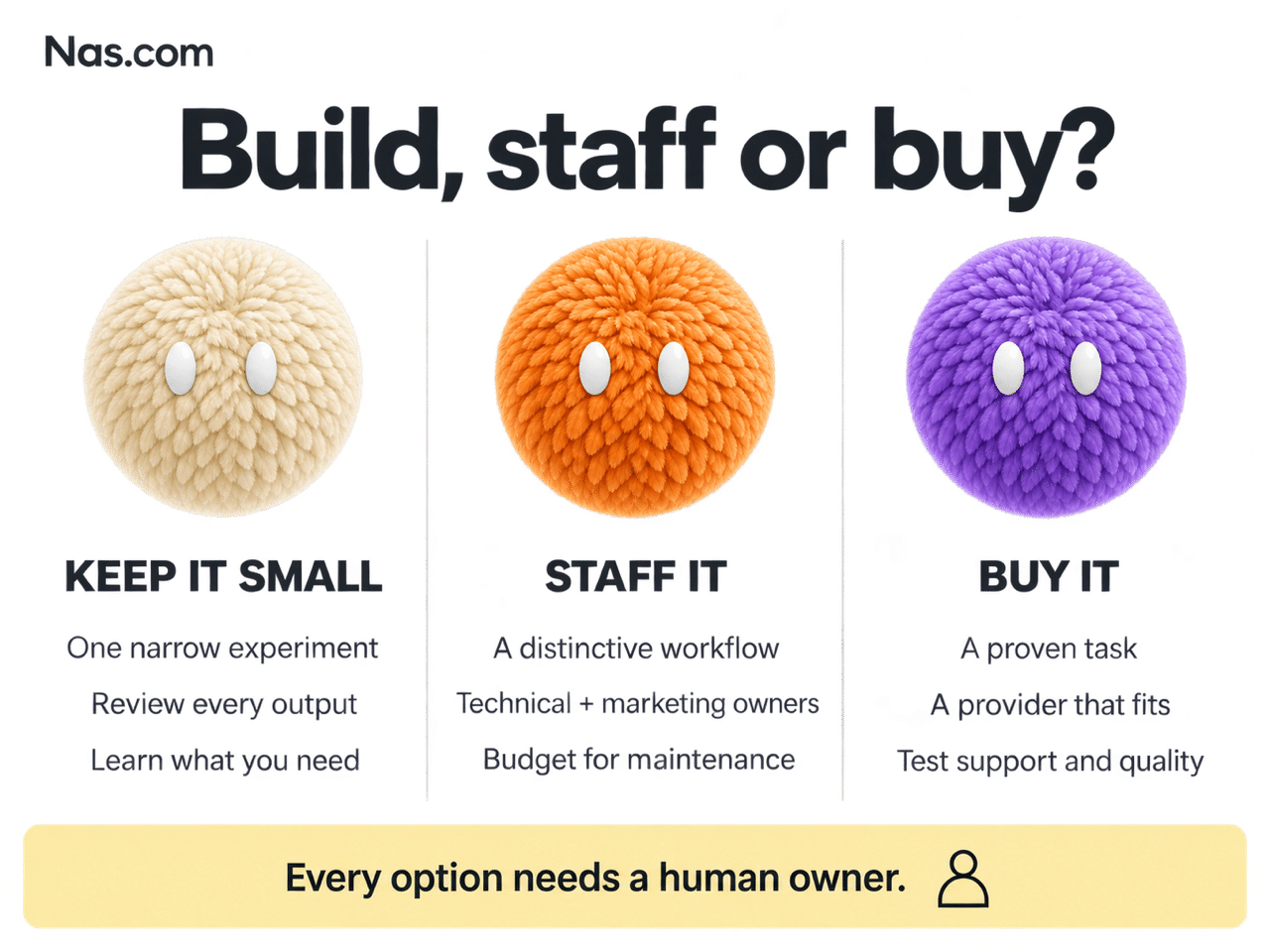
You do not have to choose between building everything and outsourcing everything. Start with the level of support the workflow needs.
A hybrid can also work. For example, you might buy a supported platform but keep a custom qualification step that reflects your sales process. Be clear about who fixes each connection when the workflow crosses those boundaries.
When building AI marketing agents makes sense
Build a prototype when you need to learn what the job really requires. A small experiment can reveal missing data, unclear goals and exceptions before you commit to a larger system.
For example, start with an agent that drafts a weekly campaign summary from approved exports. A marketer checks every output. It cannot publish, contact customers or spend money.
Building a production system is a larger commitment. It can make sense when your workflow gives the business a real advantage and existing products cannot meet the need.
- The workflow is distinctive. Your team has rules or data connections that a standard product cannot handle well.
- You have technical capacity. Someone can maintain integrations, test changes and respond to failures.
- You have marketing depth. A subject expert can define a good recommendation and catch misleading analysis.
- You can fund ongoing work. Maintenance has a place in the budget after the first launch.
However, a large engineering team does not automatically make building the best choice. Those engineers have other priorities. Compare the value of this custom workflow with the work they would postpone.
Give the internal system two owners
The technical owner keeps the system running. The marketing owner decides whether it is doing useful work. One person can hold both roles on a small team, but each responsibility must be explicit.
For example, engineering may fix a broken data connection. Marketing must still decide whether the agent used the right acquisition metric. Neither owner can replace the other with a better prompt.
When buying AI marketing agents makes sense
Buying is worth considering when the task is familiar, a product fits your workflow and you need support your team cannot reliably provide.
For example, a small performance team may want campaign monitoring across several accounts. Building every connection and maintaining each one could consume the time it hoped to save.
However, buying is only a shortcut if the product works with your actual setup. A polished demo using clean sample data does not prove it can interpret your conversion events or unusual account structure.
Ask the provider to show how its agent handles missing data, conflicting metrics and a disconnected account. Also ask which parts are standard, which require custom work and who maintains those custom parts.
Similarly, “always on” needs a clear definition. Does it mean scheduled checks, continuous monitoring or round-the-clock human support? These are different services. Confirm the coverage and what happens when something fails.
Compare the full cost of AI marketing agents
A subscription price is only part of the comparison. So is the model bill for a custom build. Both options need setup, review and ongoing changes.
First, compare the same workflow, volume, quality standard and level of authority. Otherwise, you may compare a personal reporting prototype with a service that also maintains integrations and provides support.
Use a shared planning horizon, such as one year. Then calculate:
An illustrative example, not a market price
Suppose an internal build takes 80 hours at a fully loaded labor cost of $75 per hour. That is $6,000 in setup work. If monthly maintenance takes 12 hours at the same rate, plus $200 in infrastructure, the monthly cost is $1,100.
Under those assumptions, the first year costs $19,200 before extra review or migration work. Now suppose a vendor quotes $2,000 for setup and $1,200 per month. Add four internal hours each month at $75 per hour. That route totals $20,000.
These invented figures show why a cheaper subscription or API bill cannot settle the decision. Replace every assumption with your own quote and measured hours. Next, test whether the two options actually deliver comparable results.
Also separate time saved from cash saved. Ten hours freed for campaign planning can be valuable without reducing payroll by ten hours.
Test marketing judgment, not just fluent answers
AI marketing agents need to connect campaign activity to the outcome you care about. A good test should reveal whether they understand that relationship.
Consider a campaign whose cost per acquisition rises. The agent should not automatically recommend pausing it. First, it may need to check conversion lag, tracking changes, sales quality and recent creative tests.
Create a small test set from past decisions. Include normal cases and difficult ones. Then write down what a strong answer would need to notice.
- Tracking failure: reported conversions fall, but the landing page also stopped recording events.
- Cheap, weak leads: cost per lead falls while the share of qualified opportunities drops.
- Delayed outcomes: a recent campaign has not had enough time to produce sales.
- Business constraints: demand grows for a service the team cannot currently deliver.
- Missing evidence: the correct answer is to ask for more information or escalate.
These are suggested test cases, not claims about results from our own agent. Use examples from your business and score the output before allowing live changes.
A shared Company Brain can help organize acquisition context: target customers, offers, funnel stages, conversion definitions and earlier campaign lessons. However, someone still needs to resolve conflicting sources and update the rules.
For a related workflow, see what a Meta Ads AI agent can automate. The same ownership questions apply whether the agent monitors ads, qualifies leads or prepares content.
Eight questions to ask an AI agent vendor
Ask for concrete evidence during a trial. The goal is to understand what the product does today and what your team will need to do around it.
- Can you run our actual workflow? Use approved sample data and include an awkward case, not only a clean demo.
- What does the agent read and change? Separate reporting access from permission to edit campaigns, publish or send messages.
- How does it use our marketing context? Ask who loads it, checks it and updates it.
- Can we review the evidence? Request source records, timestamps, actions taken and a way to investigate mistakes.
- How do approvals and stopping work? Test a rejected action, a paused workflow and an urgent handoff.
- Who handles failures? Confirm support hours, response expectations and ownership of broken integrations.
- How is our data handled? Review access controls, retention, deletion, subcontractors and any model-training use with the relevant internal owner.
- What happens if we leave? Check exports, account ownership, cancellation terms and the cost of transferring the workflow.
The NIST AI Risk Management Framework provides a broader reference for managing AI risks across an organization’s work. A vendor review should connect to your existing processes rather than sit in a separate marketing spreadsheet.
A practical build-or-buy decision guide
Use these questions in order. Company size can affect the stakes, but it does not answer them for you.
1. Is this a learning tool or a business dependency?
If it serves a narrow experiment and every output gets checked, keep the prototype small. If other people depend on it, move to a supported operating model.
2. Is the workflow distinctive enough to justify custom work?
If a standard product handles the job well, test it. If your process has important requirements it cannot meet, consider an internal build or a limited custom extension.
3. Can your team own the system?
Check technical capacity, marketing expertise and approved data access separately. If one is missing, find a provider or reduce the scope before expanding use.
4. Does the provider pass a real trial?
If you buy, test the actual workflow and support process. If no option meets your requirements, keep the manual process while you resolve the gap.
5. Which option produces useful work at an acceptable cost?
Compare quality, review time, reliability and the full ownership cost. Choose the option your team can sustain, then review it as usage grows.
This extends the decision tree in the original article. It makes the evaluation more explicit: buying, like building, must pass your requirements before it becomes a company dependency.
Run a four-week pilot before a wider rollout
Use the same trial for an internal prototype and a purchased product where possible. A four-week plan is a practical starting point, not a guarantee. Longer sales cycles may need more time to show downstream results.
Week 1: Define the job and baseline
Choose one recurring task, name both owners and record the current process. Measure time spent and common errors. Also define permitted actions, success criteria and stop conditions.
Week 2: Replay known cases
Run past examples with known outcomes. Include missing data and cases that require a person. Check whether the agent uses the right sources and admits uncertainty.
Week 3: Work alongside the team
Let the agent prepare outputs while people keep control. Record useful recommendations, false alarms, corrections and review time. Test who responds when a connection fails.
Week 4: Decide whether to expand
Compare results with the baseline. Expand only the actions that passed the trial. Otherwise, revise the setup, change the provider or keep the manual workflow.
For campaign monitoring, useful measures include missed issues, false alarms, time to a reviewed decision and total human effort. If you later permit actions, also track incorrect changes and recovery time.
Do not treat a brief improvement in return on ad spend as proof that the agent caused it. Seasonality, offers, creative and tracking changes can affect the same result.
Choose an owner before you choose more automation
The build-or-buy question becomes easier once you define the work, the stakes and the owner. Building can teach you what you need. Buying can provide useful expertise and support. Neither removes the need for clear business goals.
At Nas, we work on custom AI marketing agents that connect company context with specific marketing tasks. If you explore that route, bring one workflow and ask the same questions about quality, ownership and cost.
Start with a task your team can judge well. Then earn the right to expand it through reliable results. That is how AI marketing agents become a useful part of the team.
Frequently asked questions
Should a small business build or buy AI marketing agents?
Start with the task and your ability to support it. A small, reviewed prototype can help you learn. Buying may be a better fit when a proven product meets the need and you lack time or expertise to maintain it. Small company size alone does not settle the choice.
Is building an AI agent cheaper than buying one?
Not always. Include setup, maintenance, infrastructure, marketing review and recovery work. For a purchased product, include onboarding, usage fees and internal oversight. Compare the same task and quality standard over a shared period.
Can marketers build AI agents without coding?
Yes, some tools let marketers create prototypes through natural language or visual workflows. However, a working demo still needs testing, approved access and ongoing support before a team relies on it. Technical help becomes more important as the consequences grow.
Does buying an agent remove the need for a marketing owner?
No. A provider may maintain the software, but your team still owns its goals, business context and approved actions. Name a person who reviews results and works with the vendor when the workflow needs to change.
What should an AI marketing agent pilot measure?
Measure useful outputs, errors, missed issues, review time and total operating effort. Also test handoffs and failures. Connect the work to business outcomes when the data and time period support it, without assuming every change came from the agent.