Quick Answer: How should an AI marketing team work?
An AI marketing team structure combines human leaders with specialist agents. People own strategy, creative judgment, relationships, and business results. Agents monitor channels, analyze changes, and carry out approved work. A shared Company Brain connects approved campaign, CRM, and revenue data to improve customer acquisition. Start with one workflow, name its human owner, test its performance, and expand permissions only when the evidence supports it.
Most marketing teams have more useful ideas than time to act on them. Paid search needs attention. A webinar needs follow-up. Creative needs a fresh test. Meanwhile, the same small team is pulling reports and chasing approvals.
For example, a five-person team may cover Meta, Google, email, organic social, events, and customer retention. It can run all those channels in theory. In practice, each urgent task pushes another useful job into next week.
A practical AI marketing team structure addresses that capacity problem. It gives marketers help with recurring work while keeping a person responsible for the outcome. The useful question is: What should humans own, what should agents do, and how should they work together?
How AI changes the marketing team structure
Traditional teams organize people by channel or craft: performance marketing, content, design, lifecycle, and events. That still gives the work a clear owner. However, it can also leave skilled people buried in routine tasks.
A senior performance marketer may spend hours checking delivery, pulling reports, and finding which creatives are losing momentum. Similarly, a content lead may spend more time collecting feedback and resizing assets than developing a strong story.
With agents, one person can manage several recurring workflows within their role. For example, a paid growth lead might use one workflow to check spend, another to investigate lead quality, and a third to prepare a weekly review.
The human still owns the result. Agents increase the amount of work that person can review and complete. Therefore, the goal of this AI marketing team structure is broader coverage and better decisions, rather than a fixed promise about headcount.
Divide the work into monitoring, analysis, and execution
Before assigning tools or titles, split the work into three parts. This makes it easier to decide where marketing workflow automation adds value.
Monitoring: notice the changes that matter
Monitoring means checking defined signals on a useful schedule. Did spend rise unexpectedly? Did a form stop working? Has a lead waited too long for a response?
For example, an agent could compare campaign spend with a daily limit and flag an unusual jump. It needs current data, a schedule, and a clear threshold to do that job. Simply connecting a model to an ad account does not create reliable monitoring.
Also, healthy performance should not produce endless alerts. Track false alarms and missed issues so the team can tune what deserves attention.
Analysis: investigate before recommending
Analysis moves from “what changed?” to “what might explain it?” A higher cost per lead could reflect creative fatigue, a tracking problem, or a weaker landing page.
First, the agent gathers the relevant evidence. Next, it compares that evidence with the account’s normal range. It should then explain its proposed cause, show its sources, and identify what remains uncertain.
However, a plausible explanation is not proof. The marketer should be able to challenge the diagnosis and inspect the underlying data before approving an expensive change.
Execution: match permissions to the action
Execution can range from preparing a report to changing a live campaign. Those actions deserve different permissions. For example, drafting a negative-keyword list has less consequence than applying it across every campaign.
Start with recommendations. Then allow a human to approve an exact action before the agent carries it out. After testing, selected actions may run within written limits, with logs and a way to stop them.
Capabilities vary by product, connection, and account permission. The examples below describe workflows a team can design and evaluate, not features every agent provides.
Keep strategy and judgment with people
Data helps a team make choices, but it does not settle every trade-off. A campaign can win clicks while weakening the brand. Likewise, an event can have poor short-term attribution yet build relationships that matter later.
Humans should own the decisions that define the business:
- Choose target customers, markets, and positioning.
- Set the budget, priorities, and acceptable acquisition cost.
- Shape creative direction, brand voice, and original ideas.
- Handle sensitive communication and important relationships.
- Define the standards agents must meet.
- Take responsibility for the final business result.
For this reason, an AI marketing team needs more than a tool administrator. It needs experienced marketers who can judge evidence, spot weak reasoning, and decide when a proposed action makes sense.
The human owns the outcome. The agent expands the team’s capacity.
A practical AI marketing team structure
A hybrid model combines shared infrastructure with ownership inside each marketing function. One person coordinates the systems and standards. Meanwhile, channel leaders manage the agents that support their goals.
This gives the team a common foundation without sending every workflow change through one central queue. It also reduces duplicated tools and conflicting definitions of success.
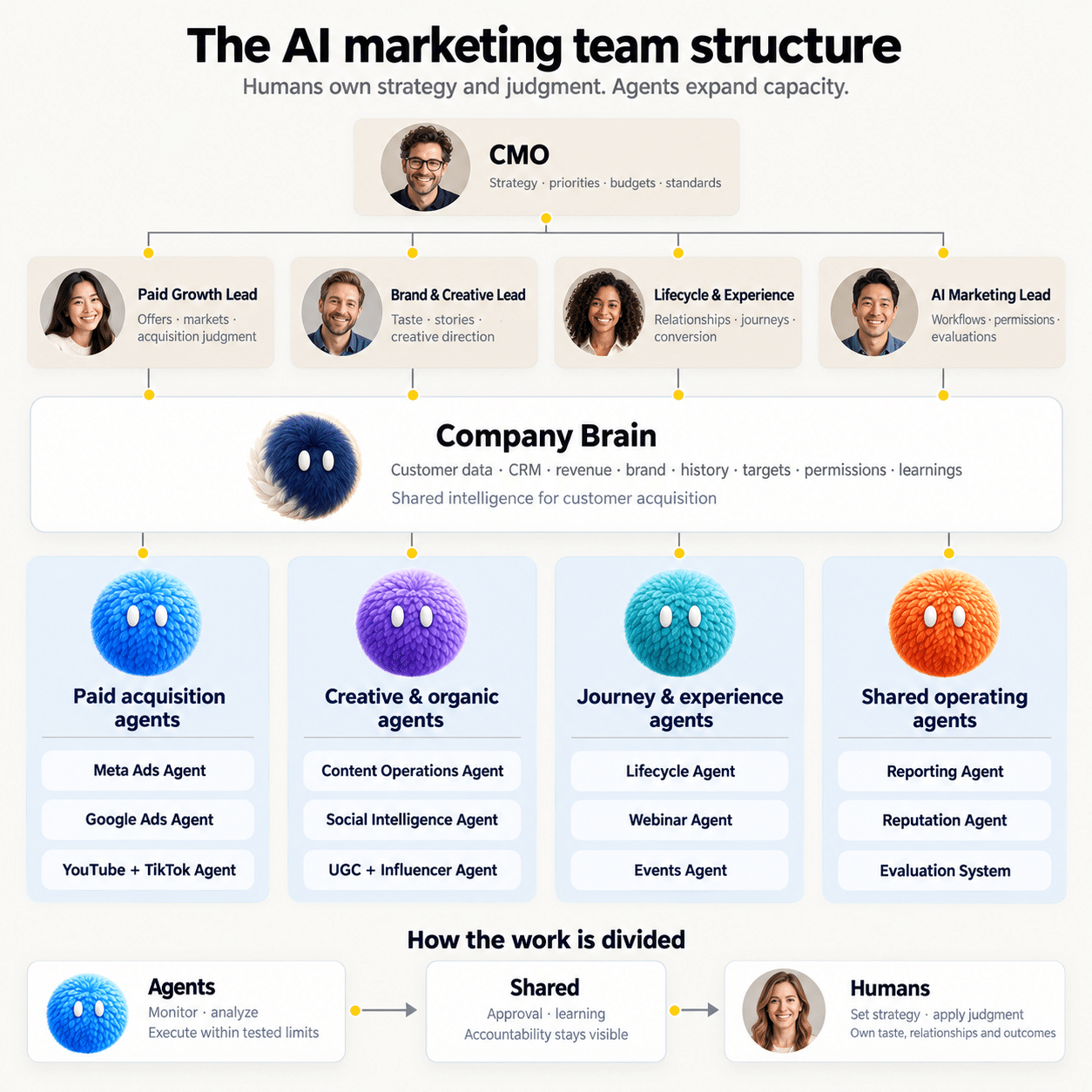
Read the team structure
The CMO sets strategy, priorities, budgets, and standards. Four human owners guide the specialist teams below.
- Paid Growth Lead: Meta Ads Agent, Google Ads Agent, and YouTube + TikTok Agent.
- Brand & Creative Lead: Content Operations Agent, Social Intelligence Agent, and UGC + Influencer Agent.
- Lifecycle & Experience: Lifecycle Agent, Webinar Agent, and Events Agent.
- AI Marketing Lead: Reporting Agent, Reputation Agent, and Evaluation System.
The Company Brain connects these teams through shared customer data, CRM, revenue, brand guidance, history, targets, permissions, and learnings. That context supports customer acquisition. Agents monitor, analyze, and execute within tested limits. Meanwhile, people own strategy, judgment, relationships, and outcomes. Approval and learning connect the two.
The CMO or head of marketing
The chief marketing officer, or CMO, sets the direction, budget, and targets. They decide where the team needs more capacity and which results matter most.
For example, the priority might be qualified sales opportunities rather than cheaper form submissions. That choice should guide every related agent. The CMO sets those goals; individual managers review day-to-day agent work.
The AI marketing lead
An AI marketing lead connects marketing, data, and engineering. This can be a dedicated role or an explicit responsibility within marketing operations. The title matters less than having a clear owner.
They maintain the shared data connections, access rules, workflow design, evaluation process, and incident response. They also coordinate vendor choices and decisions about building tools internally.
Because this work crosses functions, the lead needs marketing knowledge as well as technical judgment. Their job is to make agent work useful, traceable, and maintainable.
Senior channel and outcome owners
Senior marketers remain responsible for paid acquisition, brand and creative, organic growth, lifecycle, partnerships, or events. Each defines the agent’s job within their area.
They review important recommendations, correct weak reasoning, and decide where human taste is essential. Over time, those corrections become reusable examples and standards for the wider team.
The Company Brain: connect data to customer acquisition
The Company Brain connects approved marketing and customer data so agents can improve customer acquisition. It brings campaign results together with customer relationship management (CRM) stages, revenue, past tests, brand guidance, and business targets.
For example, a Meta Ads agent might find cheap leads while the CRM shows that few qualify. With the right shared data, it can flag that gap instead of treating low lead cost as a win.
Similarly, a content agent can learn which messages attract valuable customers. It should not repeat a failed angle simply because that result sits in another team’s report.
Shared context still needs controls. Define who can access each source, how fresh it must be, and who resolves conflicting records. Shared does not mean unrestricted access to every customer record.
How this works in a small marketing team
A small company can use the same AI marketing team structure without hiring every role shown in the diagram. One marketing lead may own strategy and paid growth, while a content specialist owns creative.
In that case, assign the systems responsibility explicitly and bring in technical support where needed. Start with one or two agents. Add more only when someone has time to review their work.
What humans and agents do in each channel
Use the cards below to divide each channel into repeatable agent work and human ownership. Agents can help with monitoring and analysis; execution requires approval or tested permissions. Start with these examples, then adapt your AI marketing team workflows to your own tools and data.
01
Meta Ads
Agents
Monitor Check delivery, rejected ads, broken forms, spend pacing, and creative fatigue.
Analyze Connect ad performance to qualified leads. Investigate whether a change comes from the creative, audience, or website.
Execute Prepare approved tests, pause selected ads, and apply budget changes within agreed limits.
Humans own
- The offer and campaign strategy
- Creative direction and new ideas
- Risk limits and major campaign changes
For a closer look at permissions, see our Meta Ads AI agent guide.
02
Google Ads
Agents
Monitor Check search terms, bids, impression share, conversion tracking, landing pages, and spend.
Analyze Find the queries that produce qualified customers and investigate where spend is wasted.
Execute Prepare keyword groups and apply approved exclusions or bid changes where the tools allow it.
Humans own
- Market priorities and commercial intent
- Acceptable customer acquisition cost
- Expansion into new demand
Review exclusions carefully: a useful shortcut can also block valuable demand.
03
YouTube and TikTok paid media
Agents
Monitor Track hook rate, viewing time, completion, clicks, conversions, frequency, and creative openings.
Analyze Find which stories hold attention, which creators attract valuable customers, and where viewers leave.
Execute Rotate approved creative, shift controlled test budgets, and pass useful patterns to the creative team.
Humans own
- The idea, talent, and story
- Cultural context and brand judgment
- What deserves the next creative investment
An agent can find the opening that worked. However, a human still needs to make something worth watching.
04
Instagram, LinkedIn, and organic social
Agents
Monitor Follow audience questions, comments, competitor activity, topic momentum, and publishing consistency.
Analyze Find themes that create useful engagement or sales conversations. Also spot a repetitive content mix.
Execute Repurpose approved work, prepare platform variants, schedule posts, and route important comments.
Humans own
- The company’s point of view
- Original insights and personal stories
- Humor, tone, and brand voice
For example, an agent can adapt a founder’s story without inventing experiences for them.
05
YouTube organic
Agents
Monitor Review retention curves, thumbnail performance, search demand, comments, and returning viewers.
Analyze Investigate where viewers leave, which topics attract subscribers, and which ideas could support a series.
Execute Prepare clips, metadata, chapters, draft translations, and distribution variants.
Humans own
- The editorial idea and storytelling
- Host performance and audience connection
- Whether to invest in a new format
Before publishing, a person checks the accuracy and tone of the supporting material.
06
UGC and influencer marketing
Agents
Monitor Track creator output, audience fit, deadlines, deliverables, documented usage rights, and results.
Analyze Compare qualified customers across creators and identify the briefs that produce natural content.
Execute Build shortlists, draft initial outreach, track deliverables, and organize approvals.
Humans own
- Relationships and negotiation
- Creator chemistry and sensitive feedback
- Final selection and brand fit
User-generated content (UGC) still needs someone who understands why a creator feels right for the brand.
07
Webinars
Agents
Monitor Check registration pace, source quality, reminder delivery, and submitted questions.
Analyze Compare which channels produce attendees and qualified sales conversations, then investigate drop-off.
Execute Send approved reminders, prepare segmented follow-up, and route interested attendees to sales.
Humans own
- The teaching and central idea
- Live interaction and audience trust
- The offer and sales approach
Automating the surrounding work gives presenters more time to prepare a useful session.
08
Physical events
Agents
Monitor Track registrations, guest mix, capacity, logistics, and follow-up status.
Analyze Review which invitations reach the right people, suggest relevant introductions, and assess pipeline over time.
Execute Prepare reminders, answer routine questions, organize introductions, and trigger approved follow-up.
Humans own
- Hospitality and room design
- Relationships and meaningful conversations
- Judgment on the day
The event should feel more personal because less time goes into administration.
09
Email, lifecycle, and reactivation
Agents
Monitor Check delivery, engagement, lifecycle stages, inactivity, and unusual conversion changes.
Analyze Find the messages that move customers forward and the segments that need different communication.
Execute Run approved sequences, reminders, and controlled tests within consent and suppression rules.
Humans own
- Lifecycle strategy and tone
- Escalation rules
- Sensitive customer communication
Our patient acquisition example shows why follow-up must connect to final outcomes.
Choose which marketing workflows to automate first
Begin with the work, then choose the tool. List the recurring jobs your team struggles to complete. Next, score each from one to five on four dimensions.
Business impact
Ask whether a better result would matter to the business. For example, finding a broken lead form could protect customer acquisition. Renaming internal files may save time, but its commercial value may be smaller.
Repeatability
Look for recognizable inputs, steps, and outputs. A daily campaign review has a clearer pattern than choosing a new market. If the process is unclear, define it before adding an agent.
Complexity
Consider how much evidence the job requires. Comparing six dashboards may be valuable work for an agent, but complexity also increases the burden of testing and maintenance.
For simple, fixed tasks, ordinary automation may be enough. Anthropic’s agent guidance recommends starting with the simplest workable approach and adding complexity when it improves the outcome.
Risk
Ask what happens if the agent is wrong. A draft report can be corrected before anyone uses it. In contrast, a large budget change or a public response can have lasting consequences.
Assess each action separately. A workflow can be complex to analyze but low risk to keep in recommendation mode. Use the following framework to choose its starting permissions.
Give every marketing agent a job description and evaluation
An AI marketing team structure needs a way to tell useful work from busywork. Before launch, write down the agent’s goal, owner, data sources, schedule, permissions, escalation rules, and success measures.
Then create an evaluation, often called an eval: a repeatable check of how well the agent performs its assigned job. Include normal cases, known failures, missing data, and situations where it should stop or ask for help.
Use an agent evaluation scorecard
Also track how much review and correction the work requires. An agent that saves drafting time but creates hours of rework may not be helping. Approval rate alone is insufficient because people can approve weak recommendations.
Anthropic’s guide to agent evaluations describes combining automated checks with model-based and human review. For marketers, that means checking both the recorded action and its actual result.
Review outcomes and restraint
Compare performance with the team’s starting point. Check whether useful coverage increased and errors fell. Then assess whether customer acquisition improved after accounting for other changes.
However, do not credit every revenue change to the agent. Seasonality, offers, and media spend can move results too. Keep a record of what changed and what evidence supports the conclusion.
Finally, reward restraint. Two well-supported recommendations may be more useful than twenty weak ones. A good agent knows when to surface an issue and when to leave a healthy campaign alone.
Increase agent autonomy one workflow at a time
Testing creates evidence for a permission decision. It does not justify giving an agent unrestricted control. Use three stages and keep a named owner at each stage.
Stage 1: Recommend
The agent monitors and analyzes but takes no external action. A marketer compares its work with their own review. First, check whether it understands the data, account history, and business targets.
Stage 2: Approve, then execute
The agent proposes the exact action, affected account, expected effect, and limits. A person approves, changes, or rejects the proposal. After execution, the agent records what happened and checks the result.
Stage 3: Act within tested limits
Allow only the specific actions that have passed review and testing. For example, an agent might send an approved reminder while campaign restructures still require approval.
Budget rules need both per-action and cumulative limits. Otherwise, repeated small changes can add up to a large increase. Also define when permissions expire, when to escalate, and how a human can stop the workflow.
This approach fits NIST’s guidance on AI oversight, which calls for clear human responsibilities, ongoing monitoring, and periodic review.
Should your AI marketing team build or buy agents?
Connecting a model to an ad account is only the beginning. Someone must maintain the schedules, data definitions, permissions, logs, and evaluations. API changes and new CRM fields can break a workflow that worked last month.
Build when the workflow is distinctive and your company can fund long-term marketing and engineering ownership. For example, a proprietary acquisition process may justify custom development.
Buy when a common workflow matters more than owning its implementation. However, check the vendor’s actual connections, controls, evaluation evidence, and support. Purchasing software does not remove your team’s responsibility for the results.
Combine the two when a specialist product can handle routine work while your team supplies its definitions, history, and review process. Ask who will maintain each part before committing.
For budget planning, compare the full cost: software or model usage, setup, data work, review time, and ongoing maintenance. Our guide to AI marketing automation costs provides additional context for smaller teams.
Put your AI marketing team structure into practice
Use this four-week plan as a starting point. The pace depends on your data, tools, and review capacity; moving to automatic execution is not a deadline.
Week 1: Map the work and assign owners
List recurring tasks and score their impact, repeatability, complexity, and risk. Then select one workflow with a clear business goal. Record who owns it and how the team handles it today.
Week 2: Connect approved data and define the job
Check data freshness, access, and the meaning of key metrics. Next, write the agent’s job description and assemble test cases. Include examples where it should raise a question rather than recommend an action.
Week 3: Run alongside the human workflow
Keep the agent in recommendation mode. Compare its findings with the marketer’s review and record errors, missed issues, useful insights, and review time. Then adjust the instructions and tests.
Week 4: Review the evidence and choose the next step
If the results justify it, test execution after human approval. Otherwise, keep improving the recommendation stage. Agree on limits, logs, and a stop procedure before any live action.
The result should be an AI marketing team structure your team can operate and improve. Start with useful coverage in one area, then expand the parts that work. People still bring the strategy, taste, and customer understanding that make the work worth doing.
Frequently asked questions
What is an AI marketing team structure?
An AI marketing team structure combines human marketers with specialist agents. People own goals, strategy, creative judgment, and accountability. Agents support monitoring, analysis, and permitted execution. Each agent needs a named owner, relevant data, clear limits, and a way to evaluate its work.
Will AI agents replace marketing teams?
Agents can automate parts of marketing jobs, but the effect on staffing varies by company and workflow. They can also help an existing team cover more channels. This framework focuses on increasing useful capacity while keeping human ownership of strategy, relationships, and results.
Who should manage marketing agents?
A senior marketer should own each agent’s goal and performance. Meanwhile, an AI marketing lead or operations owner coordinates shared systems, access rules, and evaluations. In a small team, one person can hold both responsibilities as long as ownership stays clear.
Which marketing workflows should you automate first?
Start with recurring work that matters and has clear inputs and outputs. Reporting and campaign monitoring are useful candidates. However, begin in recommendation mode and test with your own data. Simple reminders or fixed rules may need ordinary automation rather than an AI agent.
How do you measure a marketing agent’s performance?
Measure accuracy, useful findings, missed issues, review time, execution reliability, and compliance with permissions. Also track the business outcome the agent supports. Compare results with a baseline, and use test cases to check whether improvements hold across different situations.
Can a small business use this AI marketing team structure?
Yes. Treat the roles as responsibilities rather than a hiring list. A small team can start with one owner and one agent for a defined workflow. Then expand only when the time saved and quality of the work justify the added cost and oversight.
Should you build or buy AI marketing agents?
Build when the workflow is distinctive and you can maintain it over time. Buy when an existing product meets a common need and provides suitable controls. Either way, evaluate the real workflow with your own data before granting live execution permissions.