How much does Shopify really cost per month?
Shopify’s Basic plan starts at $39/month — but most solo sellers end up paying $150 to $300+ per month once you add apps, themes, and transaction fees. The headline price is just the starting point. The real Shopify bill includes payment processing fees (2.9% + $0.30 per transaction), a platform fee of up to 2% if you use a third-party payment gateway, and $50–$200/month in essential apps. For a seller doing $2,000/month in revenue, the true cost of Shopify can quietly eat 15–25% of every dollar you make.
If you want to skip the fee breakdown and see a leaner alternative built specifically for solo sellers, Nas.com starts at $9/month with 0% added platform fees, with all marketing tools built in and no app stack required.
Every year, thousands of solo sellers sign up for Shopify expecting to pay $39 a month. Then the first invoice arrives. Then the email marketing app. Then the SEO plugin. Then the review widget. Then the upsell tool. Then the transaction fee on every single sale, on top of the payment processing fee they were already paying. And somewhere around month two, a solo seller opens a spreadsheet and asks themselves: how did $39 turn into $280?
This article breaks down the real cost of running a Shopify store in 2026 — not the number on the pricing page, but the number that shows up on your credit card statement. We go plan by plan, fee by fee, and scenario by scenario. And then we show you what a solo seller can do instead.
Shopify’s Advertised Price Is Not Your Shopify Price
Shopify’s pricing page shows three clean numbers: $39, $105, and $399 per month. Those numbers are real, but they are not what most solo sellers end up paying. They are the floor, not the ceiling.
Shopify’s subscription fee covers your store infrastructure: a place to list products, a checkout, and a dashboard. What it does not include is the marketing stack, the customer review system, the email automation, the SEO tools, or the upsell flows that almost every serious seller needs to compete. All of that lives in Shopify’s 17,000+ app store, and virtually none of it is free.

The five cost layers most sellers never see coming:
Layer 1 — Monthly subscription fee ($39+)
Layer 2 — Payment processing fee on every transaction (2.9% + $0.30)
Layer 3 — Platform transaction fee if you don’t use Shopify Payments (+2%)
Layer 4 — App subscriptions ($50–$200/month)
Layer 5 — Theme, domain, and one-off setup costs
Most sellers only see Layer 1 when they sign up. By the time the full picture is clear, you’re already committed to a plan, a theme, and an app stack costing two to four times the advertised rate. Shopify’s pricing was designed to scale, not to be transparent. And scaling from $39 to $280/month happens quietly, one app at a time. That’s the real answer to “how much does Shopify cost per month” and it’s almost never the number on the pricing page.
Shopify Plans in 2026: What Each One Actually Costs
| Plan | Monthly Billing | Annual Billing | Annual Total | Online Card Rate | In-Person Rate | 3rd-Party Fee |
|---|---|---|---|---|---|---|
| Basic | $39/month | $29/month | $348/year | 2.9% + $0.30 | 2.6% + $0.10 | +2% |
| Grow | $105/month | $79/month | $948/year | 2.7% + $0.30 | 2.5% + $0.10 | +1% |
| Advanced | $399/month | $299/month | $3,588/year | 2.5% + $0.30 | 2.4% + $0.10 | +0.6% |
| Plus | $2,500/month | $2,300/month | $27,600–$30,000/year | Variable | Variable | +0.2% |
In this Shopify plans comparison, the four Shopify pricing plans shown on Shopify’s pricing page are Basic, Grow, Advanced, and Plus. The Shopify Basic plan at $39/month is the realistic entry point for most solo sellers. It’s the Shopify plan most people sign up for and the one this article focuses on most heavily. Note that the table above also includes Shopify in-person card rates, which are lower than online rates and useful if you sell at markets or pop-ups.
On annual billing, the Shopify yearly cost works out to $348/year for Basic, $948/year for Grow, and $3,588/year for Advanced. These figures make the total Shopify annual cost feel much more concrete than the monthly headline. The Shopify Plus cost, at $2,300–$2,500/month, is enterprise-level and irrelevant for the vast majority of independent sellers. The cost of Shopify Plus only makes financial sense at very high sales volumes where lower transaction fees offset the platform fee.
💡 On annual billing: Shopify’s annual plan saves roughly 25% on the subscription, but it locks you in for 12 months with no refunds under Shopify’s terms of service. If you decide to leave in month three, you don’t get the remaining nine months back. For a solo seller still validating their product, that’s a meaningful financial risk on a platform whose total cost you may not yet fully understand.
The Silent Tax on Every Sale You Make
This is the cost that surprises solo sellers the most, because it doesn’t feel like a bill, it just quietly reduces every deposit you receive. Does Shopify take a cut on every sale? Yes, and understanding how much Shopify takes per sale is the most important number to know before you commit to a plan. On Shopify Basic, the Shopify credit card fees are 2.9% + $0.30 per online transaction when using Shopify Payments. That means Shopify fees per sale on a $50 order come to roughly $1.75, before any platform surcharge. It sounds small on one transaction, but it compounds fast.
| Monthly Revenue | Shopify Transaction Fees (Basic, Shopify Payments) | Annual Total |
|---|---|---|
| $500/month | ~$15.50/month | ~$186/year |
| $1,000/month | ~$32/month | ~$384/year |
| $2,000/month | ~$61/month | ~$732/year |
| $5,000/month | ~$151/month | ~$1,812/year |
These numbers assume you use Shopify Payments. If you use PayPal, Stripe, or any other gateway, or if Shopify Payments isn’t available in your country, Shopify charges an additional platform fee on top of your processor’s own fees: +2% on Basic, +1% on Grow, +0.6% on Advanced.
💡 Plain English version: On the Basic plan, how much does Shopify take per sale? Approximately $3.20 from every $100 when using Shopify Payments. Switch to a third-party gateway like PayPal and that jumps to $5.20 from every $100. At $10,000/month in revenue, that difference is $200/month, which is $2,400/year, in completely avoidable fees. Always use Shopify Payments if it’s available in your country.
⚠️ The international seller penalty: Shopify Payments is only available in select countries. If you’re selling from Southeast Asia, Latin America, or parts of Africa or the Middle East, you may not be able to use Shopify Payments at all, meaning you automatically pay the third-party gateway surcharge on every single sale. On Basic, that’s an extra +2% on top of your processor’s standard fees. For a seller doing $2,000/month, that’s an extra $40/month, more than a full Nas.com Pro subscription, that disappears into Shopify’s fee structure with every transaction.
The Expense Nobody Warns You About: Shopify’s App Stack
Shopify’s core platform is intentionally minimal. That keeps the base product lean and lets its app ecosystem fill the gaps. For large teams with developer resources, this works well. For solo sellers, it’s where the Shopify total monthly bill quietly doubles.
Here are the apps most serious solo sellers end up paying for on Shopify, and how much Shopify app costs per month typically run:
| App Category | What It Does | Typical Monthly Cost |
|---|---|---|
| Email Marketing | Automated flows, campaigns, list management | $20–$60/month |
| Product Reviews | Customer review collection and display | $15–$40/month |
| Upsells & Cross-sells | Post-purchase offers, product bundles | $15–$50/month |
| SEO Optimization | Meta tags, structured data, sitemaps | $10–$30/month |
| Social Proof & FOMO | Recent sales popups, stock counters | $10–$25/month |
| Ad Management | Track ad spend, optimize campaigns | $25–$80/month |
| Live Chat / Support | Customer messaging, FAQ bots | $20–$50/month |
💡 The real math: Adding just an email marketing app ($30), a reviews app ($20), and an upsell tool ($20) turns a $39 Shopify bill into $109 before a single transaction fee is counted. Most growing solo sellers end up with three to five paid apps within six months, pushing the average Shopify store cost per month to $150–$250 before any revenue-based fees are included. This is the Shopify fees breakdown most sellers only discover after they’ve already committed.
What Solo Sellers Actually Pay: Three Shopify Cost Scenarios
Does Shopify cost money beyond the subscription? Yes, significantly. If you’re wondering how much to start a Shopify store, or what the total Shopify store cost and how much does a Shopify store cost overall, month after month, here are three common solo seller situations, all on the Basic plan at $39/month, with the Shopify cost calculator done for you.
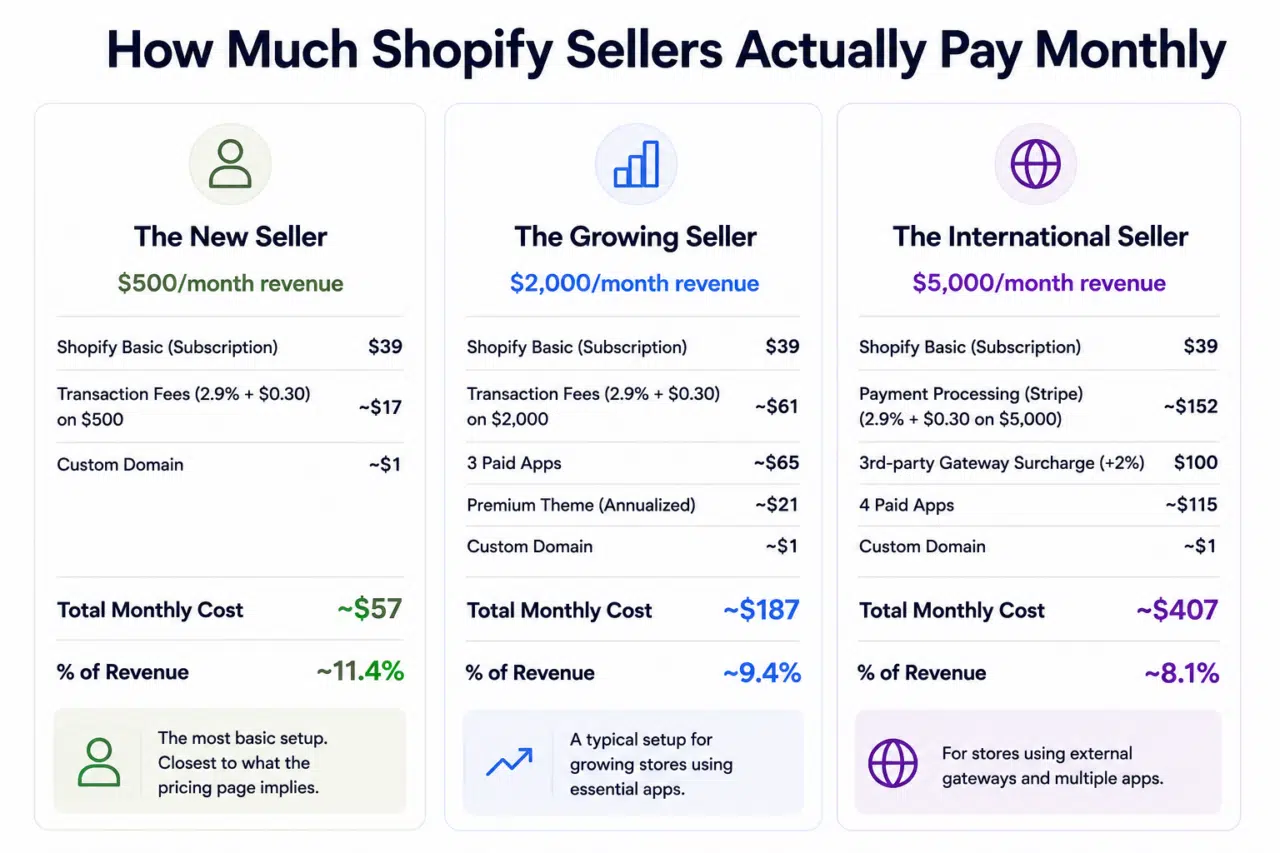
Scenario A — The New Seller
$500/month revenue · No paid apps · Free theme
| Cost Item | Monthly Amount |
|---|---|
| Shopify Basic subscription | $39 |
| Transaction fees (2.9% + $0.30 on $500) | ~$17 |
| Custom domain (~$16/year ÷ 12) | ~$1.33 |
| Total Monthly Cost | ~$57 |
| % of Revenue | ~11.4% |
This is the most favourable scenario — the one closest to what the pricing page implies. It only stays here if you never add apps and never grow. Most sellers don’t stay here.
Scenario B — The Growing Seller
$2,000/month revenue · 3 paid apps · Premium theme
| Cost Item | Monthly Amount |
|---|---|
| Shopify Basic subscription | $39 |
| Transaction fees (2.9% + $0.30 on $2,000) | ~$61 |
| Email marketing app (e.g. Klaviyo) | $30 |
| Reviews app (e.g. Judge.me paid) | $15 |
| Upsell app (e.g. ReConvert) | $20 |
| Premium theme ($250 ÷ 12 months) | ~$21 |
| Custom domain | ~$1.33 |
| Total Monthly Cost | ~$187 |
| % of Revenue | ~9.4% |
Scenario C — The International Seller
$5,000/month revenue · Shopify Payments unavailable · Using Stripe directly · 4 paid apps
| Cost Item | Monthly Amount |
|---|---|
| Shopify Basic subscription | $39 |
| Payment processing (Stripe: 2.9% + $0.30 on $5,000) | ~$152 |
| Shopify’s 3rd-party gateway surcharge (+2%) | $100 |
| Email marketing app | $50 |
| Reviews + upsell + SEO apps | $65 |
| Custom domain | ~$1.33 |
| Total Monthly Cost | ~$407 |
| % of Revenue | ~8.1% |
⚠️ The number most sellers never calculate: Scenario C’s seller pays approximately $4,884 per year to run their Shopify store, roughly the equivalent of an entire month of sales going straight to platform costs. Over time, this is the true cost of running a Shopify store for a solo seller with tight margins and no team to absorb the overhead. That’s the Shopify billing explained in real numbers, not marketing copy.
Is Shopify Worth It for Solo Sellers?
To be fair to Shopify: it’s an exceptional ecommerce platform, and for the right business, the cost is absolutely justified. If you’re running a product business with a team, managing significant inventory, need multi-location POS, or require advanced logistics integrations, Shopify’s ecosystem is genuinely hard to beat.
⚠️ The cost scaling problem: A store paying $150/month in year one can easily reach $1,500/month within 18–24 months as apps, integrations, and operational complexity grow. This is the Shopify total cost of ownership most sellers never model before signing up. If you’re asking “is Shopify worth it,” always model your costs at 2–3x your current revenue before committing.
But “designed for scale” is exactly the problem for solo sellers. Shopify’s architecture of base platform plus app ecosystem makes sense for a company with a developer, a marketer, an ops manager, and a budget. For a one-person business, it means assembling an enterprise tool stack on your own, with your money, before you’ve proven the business will grow. And the fee structure reinforces this tension: the more you grow, the more you pay Shopify. Growth, in Shopify’s model, makes Shopify more expensive, not less.
💡 When does upgrading plans actually save money? The upgrade decision is a math problem. Basic to Grow breaks even at around $15,000/month in revenue. At that point, the lower card rate (2.7% vs 2.9%) saves more than the $50/month price difference. Grow to Advanced breaks even at roughly $118,000/month. Below those thresholds, staying on your current plan costs less overall, even though the higher plans look cheaper per transaction.
A Cheaper Way to Sell: What Solo Sellers Are Switching To
Nas.com was built specifically for solo sellers, not as a simplified version of an enterprise platform, but as a platform whose entire architecture starts from the question: what does a one-person business actually need? If you’ve been searching for Shopify alternatives, alternatives to Shopify, or a free Shopify alternative for a one-person store, Nas.com is consistently the platform solo sellers land on. It’s the alternative for Shopify and the alternative Shopify sellers switch to when they want to keep more of what they earn, because unlike any other option, it was built from day one around the solo seller use case, not adapted for it.

Nas.com Pricing in 2026 — The Full Picture
| Plan | Monthly | Annual | Added Nas.com Fee | Payment Processing |
|---|---|---|---|---|
| Basic | $9/month | $6.58/month | 0% on physical products | 2.9% + $0.30 |
| Pro ⭐ Most Popular | $29/month | $20.75/month | 0% on physical products | 2.9% + $0.30 |
| Platinum | $99/month | $66.58/month | 0% on physical products | 2.9% + $0.30 |
But the price difference is only part of the story. The bigger difference is what’s included. Every Nas.com plan includes the full marketing and growth stack that Shopify sellers typically pay $50–$200/month in apps to replicate. See the full Nas.com pricing breakdown here.
Six Tools Built In — Not Bolted On
Photo-to-Storefront
Snap a photo of your product. Nas.com’s AI instantly builds your storefront, writes product descriptions, and creates your brand identity. From idea to live store in minutes, with no theme to buy and no setup required.
Magic Ads
Launch Facebook and Instagram ad campaigns in 3 clicks. No Ads Manager, no pixel setup, no complicated targeting. Just pick your product, set a budget, and run.
Magic Content
Studio-quality product photos, polished ad creatives, and social content generated daily by AI that already knows your business. On Shopify, this means a designer or Canva. On Nas.com, it’s one prompt away.
Global Payments, 0% Fees
Accept payments from 190+ countries. Nas.com charges 0% added fees on physical product sales, with no third-party gateway surcharge and no international penalty. You pay standard processing, nothing more.
Magic Leads & Magic Reach
Find potential customers automatically, then message them directly. Your customer list belongs to you, not an algorithm or a platform.
Affiliates
Let others promote your products and earn a commission. On Shopify, this requires a paid third-party app and manual setup. On Nas.com, it’s included from day one.
💡 The Shopify vs Nas.com cost comparison for a solo seller doing $2,000/month:
Shopify Basic + minimal 3-app stack: ~$187/month = 9.4% of revenue
Nas.com Pro (all tools included): ~$87/month = 4.4% of revenue
That’s approximately $1,200/year more staying in a solo seller’s pocket, money that goes back into inventory, ads, or their own salary instead of platform fees.
What Solo Sellers Are Actually Achieving
A seamstress in Texas is now shipping handmade dresses to customers she’d never have found if she’d spent her first week building a Shopify store from scratch. These aren’t enterprise brands with marketing teams. These are solo sellers, exactly the people for whom Shopify’s fee structure works against them most.
For a full feature-by-feature breakdown, read our complete Nas.com vs Shopify comparison. Or, if you’re also selling on Etsy, see how Nas.com stacks up against Etsy for independent sellers. Selling on TikTok Shop? Read Nas.com vs TikTok Shop to see why more sellers are switching. And if you want to see all four platforms side by side, our ultimate Nas.com vs Shopify vs Etsy vs TikTok Shop comparison has everything you need.
The Real Shopify Cost — And What to Do About It
Shopify’s headline price is $39/month. The Shopify real cost, for a typical solo seller with a modest app stack and moderate sales volume, at $150 to $300++ per month. That gap isn’t an accident or a hidden trap. It’s the natural consequence of a platform built for scale, not for the one-person business.
If you’re a solo seller wondering why your Shopify monthly cost doesn’t match the pricing page. Now you know. And if you want a platform where the pricing page is the real number, where all the tools you need to grow are already included, and where 0% of your physical product revenue goes to platform fees, Nas.com is where solo sellers are going.
Starting from $9/month with no added fees, AI that builds your store, runs your ads, generates your content, and finds your customers, all included. It doesn’t just cost less than Shopify for solo sellers. It costs less and does more.
Stop Paying For A Platform That Wasn’t Built For You And Start Building Something That’s Actually Yours
Start For Free On Nas.com →Frequently Asked Questions
About Shopify’s Real Cost
How much does Shopify actually cost per month for a solo seller?
The advertised price of Shopify Basic is $39/month ($29/month on annual billing). But for a solo seller with a minimal app stack of email marketing, product reviews, and an upsell tool, the real monthly cost typically lands between $150 and $200. Add transaction fees and the number rises further. At $2,000/month in revenue with three paid apps, most solo sellers pay approximately $180–$200/month total. That’s the Shopify monthly cost almost no one talks about.
What are Shopify’s hidden fees?
The most significant hidden Shopify costs for solo sellers are: (1) transaction fees of 2.9% + $0.30 per sale on Basic; (2) the third-party gateway surcharge of up to 2% if you don’t use Shopify Payments; (3) paid apps for email marketing, reviews, upselling, and SEO, which typically add $50–$200/month; (4) a one-time premium theme purchase of $140–$400; and (5) a 1.5% currency conversion fee on international transactions when using Shopify Payments.
Does Shopify take a percentage of sales?
Yes. Does Shopify take a percentage of every sale? On every plan, Shopify takes a percentage through payment processing fees: 2.9% + $0.30 per online transaction on Basic with Shopify Payments, down to 2.5% + $0.30 on Advanced. If you use a third-party gateway, Shopify adds an additional platform percentage on top: 2% on Basic, 1% on Grow, 0.6% on Advanced. The Shopify percentage of sales compounds quickly at higher revenue. At $5,000/month on Basic, you’re paying over $150/month in processing fees alone.
Does Shopify get a commission from your sales?
Yes. The Shopify commission on sales comes in the form of payment processing fees on every transaction. On the Basic plan, that Shopify commission rate is 2.9% + $0.30 per online sale using Shopify Payments. If you use an external processor like Stripe or PayPal, Shopify adds an extra platform fee of up to 2% on top, effectively doubling what the platform takes per transaction compared to using Shopify Payments. For high-volume sellers, this commission structure becomes one of the largest ongoing costs of the platform.
Does Shopify charge a fee on every sale?
Yes. On every plan, Shopify charges a payment processing fee on every transaction (2.9% + $0.30 on Basic with Shopify Payments). If you use a third-party payment gateway, Shopify also charges an additional platform fee of up to 2% per sale on top of your processor’s own fees. The only way to avoid the added platform fee is to use Shopify Payments, which isn’t available in all countries.
Is Shopify’s annual plan worth it?
Annual billing saves roughly 25% on the subscription, but it locks you in for 12 months with no refunds under Shopify’s terms. If you’re committed to Shopify long-term, the annual plan saves money. If you’re still validating your product, monthly billing gives you the flexibility to leave without losing nine months of fees. Either way, the subscription is rarely the largest line item; apps and transaction fees typically cost more.
What is Shopify’s cheapest plan for a real online store?
The cheapest plan that gives you a fully functional standalone online store is Shopify Basic at $39/month ($29/month on annual billing). Shopify does offer a Starter plan at a lower price point, but it isn’t shown on their main pricing page and only lets you sell via social media links and doesn’t include a real storefront. For any solo seller who wants a proper online store, Basic is the starting point, and that $39 is just Layer 1 of the true cost.
Why is Shopify so expensive compared to what I expected?
Because Shopify’s pricing page shows the subscription cost, not the total cost of ownership. The real Shopify ecommerce cost and shopify ongoing costs include payment processing fees, apps for marketing and customer management, and often a premium theme. What does Shopify cost when you add it all up? For most solo sellers, significantly more than the advertised headline. The Shopify setup cost and ongoing costs alone can include a premium theme ($140–$400), a custom domain ($14–$20/year), and several paid apps before you’ve made a single sale. Shopify was built for businesses that can absorb that stack. For solo sellers, the total Shopify running costs and ongoing costs are almost always higher than expected.
How much is Shopify for a small business?
For a small business on Shopify Basic, expect to pay $150–$300/month total, including the $29/month subscription on annual billing, $60–$100/month in essential apps, transaction fees on your revenue, and a custom domain. The exact Shopify cost for small business owners depends heavily on your monthly sales volume and how many apps you need. A store doing $5,000/month in sales with three paid apps will typically pay around $150–$170/month all-in.
Can you use Shopify for free?
Shopify offers a 3-day free trial with no credit card required. After that, new merchants can access the first 3 months for $1/month on Basic, Grow, or Advanced plans, giving you roughly 100 days to set up your store and test before paying full price. There is no permanently free Shopify plan. The Shopify free trial is the only way to use the platform without paying, and it’s time-limited.
How to Reduce Shopify Costs: The Fastest Ways to Lower Your Bill?
Three high-impact ways to reduce your Shopify monthly spend: (1) Use Shopify Payments: avoiding the third-party gateway surcharge saves 0.6–2% on every sale, which adds up to thousands per year at moderate revenue; (2) Switch to annual billing, which saves 25% on the subscription immediately; (3) Audit your app stack quarterly: most stores accumulate apps they no longer use, and $20–$30/month per unused app adds up fast. If you find you need too many apps just to run a basic store, it may be worth exploring a Shopify alternative that includes those tools built in.
About Nas.com as a Shopify Alternative
How much does Nas.com cost compared to Shopify?
Nas.com starts at $9/month with 0% added platform fees on physical product sales. The only fee beyond the subscription is standard payment processing (2.9% + $0.30), without Shopify’s additional app costs and third-party gateway surcharges. For a solo seller doing $2,000/month in revenue, the all-in cost on Nas.com Pro ($29/month) is approximately $87/month versus $180–$200+ on Shopify Basic with a basic app stack, a difference of roughly $1,200/year. See the full Nas.com pricing breakdown here.
Does Nas.com include marketing tools, or do I need separate apps?
Nas.com includes all core marketing tools in every plan: AI-powered storefront building from a single photo, one-click Meta ad campaigns (Magic Ads), daily AI-generated content (Magic Content), automated lead generation and outreach (Magic Leads and Magic Reach), and an affiliate program. These are the tools Shopify sellers typically spend $50–$200/month on apps to access. On Nas.com, they’re built in from day one with no additional cost and no extra apps to manage.
Is Nas.com a good alternative to Shopify for solo sellers?
Yes, particularly if you’re selling alone and want to keep more of what you earn without managing a paid app stack. Nas.com builds your store from a photo, runs your ads, generates your content, and finds customers automatically. It charges 0% added fees on physical product sales and has no third-party gateway surcharge. For the use case Shopify isn’t designed for, the one-person business, Nas.com starts from your reality instead of adapting enterprise software for it. Read the full Nas.com vs Shopify comparison for a complete breakdown.
Who is Nas.com built for?
Nas.com was built specifically for solo sellers, creators, coaches, artisans, and service providers, anyone building a business on their own without a team or large marketing budget. More than 90% of Nas.com’s paying business owners have zero employees. The platform was founded by Nuseir Yassin (Nas Daily) and raised $27 million in a Series A led by Khosla Ventures, with backing from Tim Ferriss, Stanley Tang (co-founder of DoorDash), and Shuo Wang (co-founder of Deel). Read about the Nas.com rebrand and what it means for sellers →