
JUIL.
21
mar., 21 juil.
En ligne
5
j
3
h
14
min
26
seconde



À propos
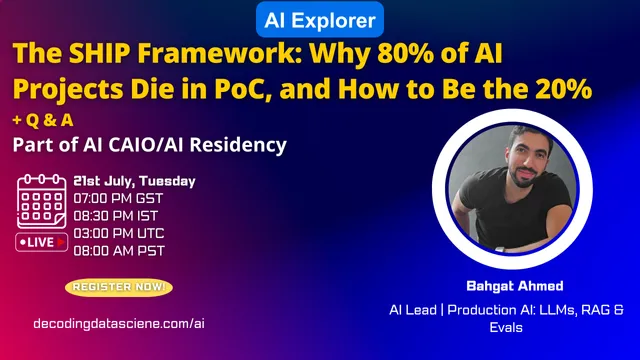
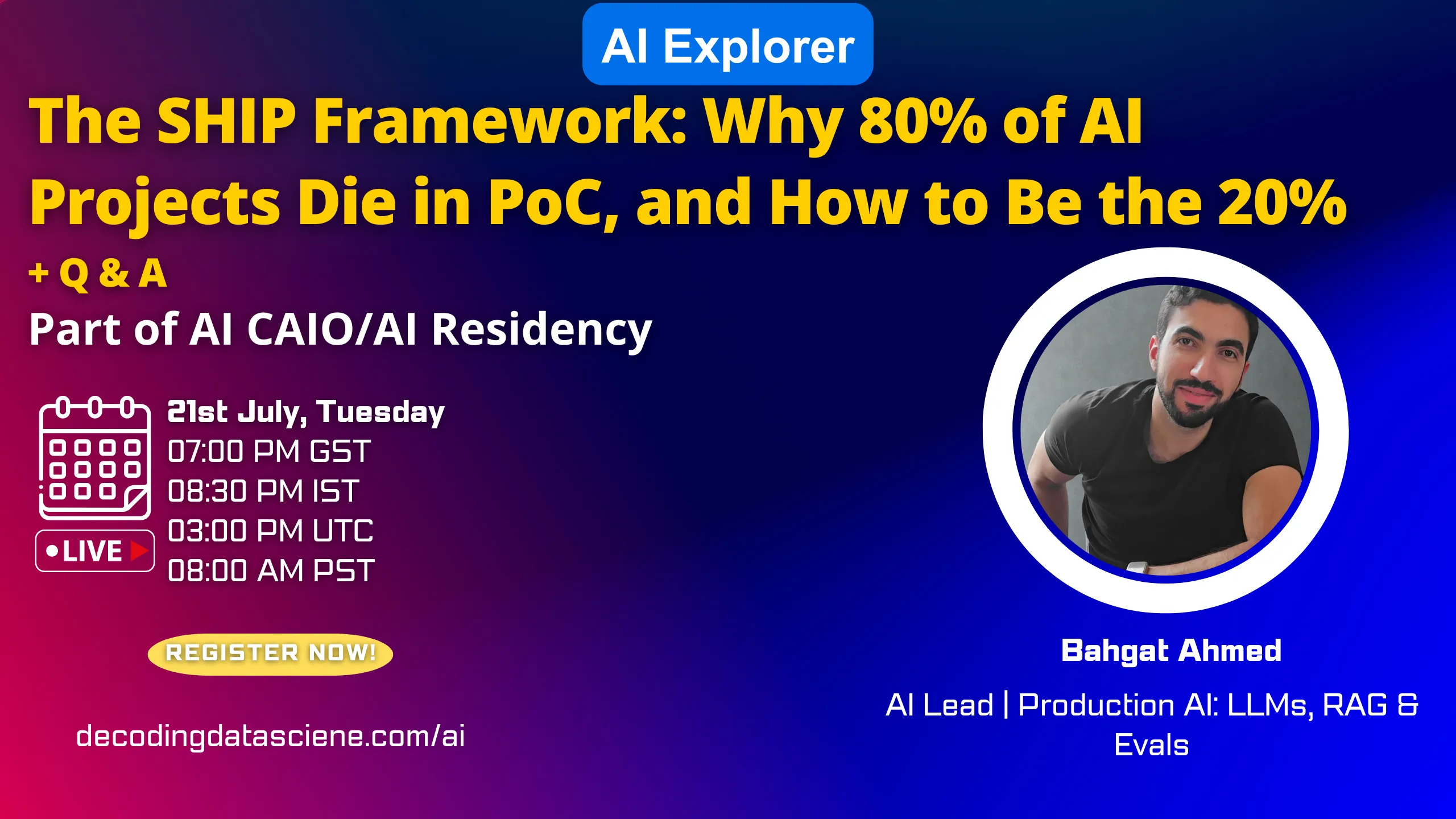
Most AI projects don't fail because the model isn't good enough. They fail because of how the problem was chosen, the metrics people trusted, how the team worked, and everything around the AI. The numbers are hard to ignore: more than 80% never make it to real use, and the reason is rarely the technology. This talk is about how to approach an AI project so it actually ships, a way of thinking about the problem, the people, and the proof, instead of a list of tools. We'll walk through the common ways projects die in PoC, and a simple framework (I call it SHIP) to think through your own. Useful whether you build AI, fund it, or decide on it.
- Why most AI projects die in PoC, and why the model is rarely the reason.
- The SHIP framework: a simple way to think through whether an AI project will actually ship.
- A practical checklist to pressure-test your own project, whether you build it or decide on it.
About Speaker
Bahgat Ahmed is an AI lead who builds systems that work in production, not demos or prototypes: systems that handle millions of records, meet government-grade requirements, and keep improving over time. Across finance, education, government, and enterprise, he's learned the hardest part of AI isn't the model, it's everything around it: evaluation that catches what benchmarks miss, feedback loops that actually improve, and the gap between "works on my laptop" and "works in production," where most projects die. He runs the 6 AM LLM Club, mentoring engineers into production AI roles, and writes about what really works in production AI
Part 2 Kahoot quiz and Community Initiative


Lieu