The GenAI Engineer Interview — 551 Questions, Answered Out Loud
Description
You knew the answer. You still got rejected.
That's the part nobody explains. You understood the question. You'd read about it. And somewhere between knowing it and saying it, you lost the room.
You talked for four minutes when they wanted forty seconds. You said "I'd use LangChain" when they asked how something works. You said "it should be fast enough" and they asked for a number and you didn't have one. You said your system got better and they asked how you measured it, and the room went quiet.
You weren't short on knowledge. You were short on the answer.
This kit is 441 pages of the answers. Not summaries of them — the actual sentences, in spoken form, timed to 30 seconds.
What's inside
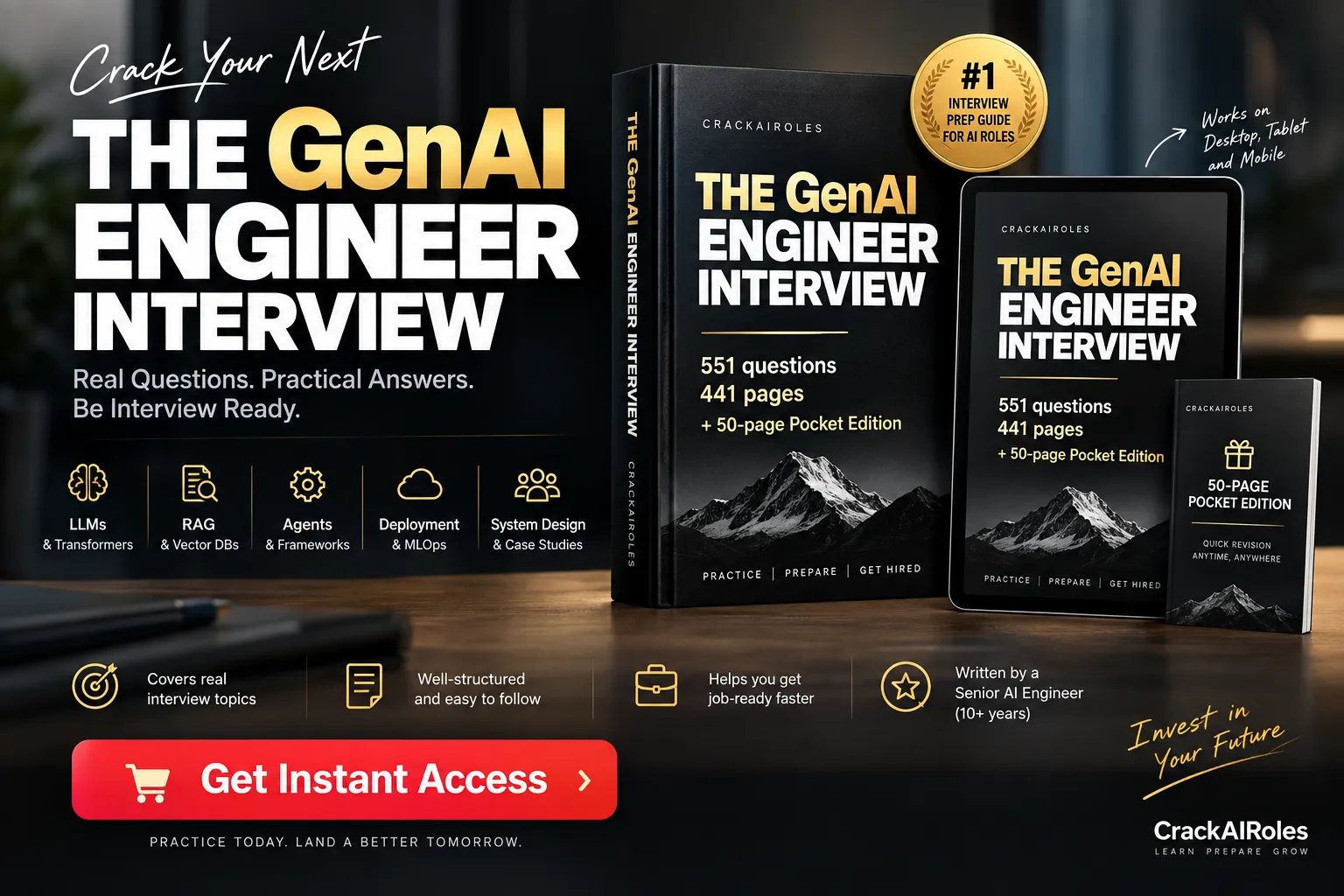
551 questions across 22 sections and 6 appendices
185 deep questions.Every one is built in four layers:
The 30-second answer written the way you say it out loud, not the way a textbook writes it
The deep answer for when they push, with the mechanism and the numbers
- The tradeoffs — what you'd pick, under which constraints, and what would change your mind
- The follow-ups — the next three questions they'll ask
- The wrong answer — a realistic, confident-sounding answer that fails, and the reason interviewers reject it
366 rapid-fire questions with the trap follow-up on each. Cover the answer, say yours, check. They work as flashcards.
Six worked system designs, done end to end — an enterprise knowledge assistant, contract review, clinical Q&A with safety gates, a support agent that issues refunds, a multi-tenant LLM platform, and a document extraction pipeline. Each with requirements, architecture, deep dives, evaluation, failure modes, and the cost in rupees and dollars.
Ten coding drills with runnable code: attention in NumPy, top-k/top-p sampling, BPE, chunking, a minimal RAG with citations and abstention, streamed tool-call parsing, prefix caching, async batching, a KV cache.
52 code blocks. 44 of them were actually run for this edition and their real output is printed in the book. The other 8 need an API key or a package that can't run offline — they're marked, and syntax-checked, not faked.
A recap sheet after every section, plus a master cheat sheet, a glossary,
a bibliography and an index.
And a 50-page Pocket Edition — every recap sheet and the full cheat
sheet, sized for a phone. It's the file you read on the cab ride to the
interview. Both PDFs are included in one download.
The sections
Foundations (ML, deep learning, NLP) · Transformers · LLM behaviour:
decoding, hallucination, context, cost · Reasoning models and test-time
compute · Prompt and context engineering · Structured outputs and tool
calling · Fine-tuning and alignment · Inference, serving and optimisation ·
Multimodal, speech and Indian-language AI · RAG foundations · Embeddings and
vector search · Advanced RAG · RAG evaluation and production · Agent
fundamentals · Agent frameworks and protocols (LangGraph, MCP, A2A) · Agents
in production · Evals and LLMOps · Security, safety and guardrails · Backend
and deployment · The GenAI system design round · Coding round and project
deep-dive.
Who it's for
- Backend, full-stack or data engineers moving into AI roles, who can use
the tools but freeze when asked how they work
- Engineers with 2–8 years of experience interviewing for AI Engineer,
GenAI Engineer, LLM Engineer or Agent Developer roles
- Senior engineers who keep getting downlevelled in the system design round
- Anyone who has built a RAG project from a tutorial and is quietly afraid
of the first question that goes past it
What changes after you read it
- You answer in 30 seconds and stop, instead of talking for four minutes
- You give a number — derived, measured, or clearly labelled as
illustrative — instead of "it should be fine"
- You bring up evaluation, cost and failure modes before they ask
- You can run a 45-minute system design round with a structure, not a guess
- You hear the wrong answer forming in your own mouth, and you catch it