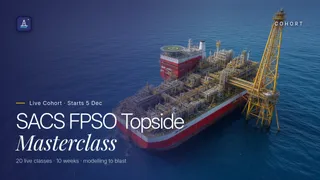

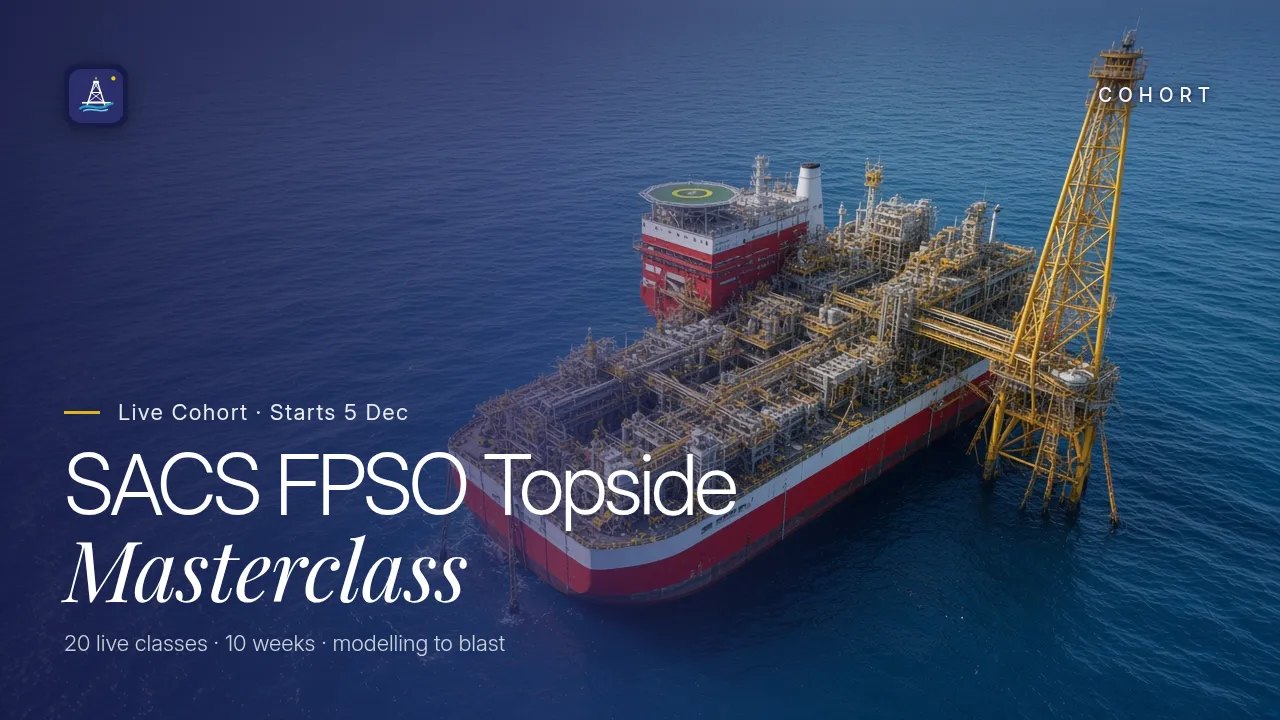
Subtitle: 10 weeks, 20 live classes. Take an FPSO topside module from first model through in-place, lifting, load-out, transportation, fatigue and blast. Who it's for • Anyone planning to start a career in offshore topside or FPSO structural work • Structural and civil engineers moving into offshore topside work • Naval architects and marine engineers who need hands-on topside analysis • Offshore engineers who want a complete FPSO module workflow in SACS, not just in-place • Engineers in India, the Middle East and SE Asia who need a weekend class that fits around work (classes are 6:00–8:00 PM IST) What you'll be able to do By the end you'll be able to build an FPSO topside module in SACS and run, interpret and defend the results for in-place, lifting, load-out, transportation, fatigue, blast and dropped-object checks. That means engineering judgment, not just button clicks. Syllabus (each week = Saturday teaching + Sunday lab, 2 hours each) 1. FPSO fundamentals (5–6 Dec): FPSO operations, offshore facilities, topside architecture and the design process; ship structure basics, GA drawings, coordinate systems and midship sections 2. Engineering inputs and codes (12–13 Dec): the inputs you need before modelling a topside module; IACS, API RP 2A / 2FB, DNV-ST-N001 and marine warranty requirements 3. Model the topside module (19–20 Dec): geometry, Z-coordinates, local vs global axes, member releases and fixity; lab — build the module in SACS 4. Motions and load generation (26–27 Dec): roll, pitch and converting vessel motions into design accelerations; self-weight, marine distributed loads, overrides and non-modelled weight 5. Load application and load cases (2–3 Jan): gravity, wind, live loads, dummy members, weight control and hull deflection; equipment and piping loads, operating / extreme / damage cases 6. In-place analysis (9–10 Jan): combinations, AMOD and verifying loads; member unity checks, joint redesign, and a first pass on equipment bases, stairs and secondary members 7. Lifting and weighing (16–17 Jan): onshore, inshore and offshore lifts, DAF and contingency factors; the lifting model in SACS, tension-only slings, COG envelope and skew lift 8. Load-out and transportation (23–24 Jan): yard-to-barge load-out, SPMT supports and load-transfer checks; transport model, tow loads, combinations and joint can 9. Dynamics and fatigue (30–31 Jan): mode-shape extraction — mass, constraints and dynamic runs; SCF, directional probability, damage and fatigue life 10. Blast, dropped object and wrap-up (6–7 Feb): strength-level blast and an introduction to ductility-level blast; dropped-object energy and risk zones, then a capstone review Schedule • Live on MS Teams, Saturday and Sunday, 6:00–8:00 PM IST (4:30 PM UAE · 7:30 PM WIB · 8:30 PM MYT) • 5 Dec 2026 → 7 Feb 2027. 10 weekends, including 26–27 Dec. • Every class is recorded and available in Nas for 12 months (streaming only, no downloads) Pricing • $449 • Previous TOE Academy cohort or recording buyers: ask for the alumni code Included • 20 live classes (10 Saturdays and 10 Sundays, 2 hours each) • 12-month recording access (streamed in Nas) • Capstone model review • Cohort discussion space inside the TOE Academy community Faculty Arjun Viswanathan FAQ Do I need a SACS licence? You'll get the most out of it with access to a SACS licence (employer, university or trial licence). You can still follow every class and the reasoning without one. I've never used SACS. Can I join? Basic SACS knowledge helps. Taking the free SACS Mini-Course beforehand is the best start if you are new to the software. What if I miss a live class? Recordings go up within 24h and stay available for 12 months, streamed inside Nas. They aren't downloadable. What's the time commitment? 4 hours a week live (Saturday and Sunday evenings), plus lab practice.