Quick Answer: How are marketing roles changing?
AI agent management means setting goals, supplying context, controlling permissions, and evaluating the work agents do. In marketing, those duties increasingly sit alongside familiar roles: performance marketers direct campaign investigations, creative leads review generated assets, and CMOs set priorities. People still own business decisions. The opportunity is a hybrid team where experienced marketers can direct more useful work, with clear limits and support.
A performance marketer still owns campaign results. However, the job can now include briefing an agent, questioning its findings, and approving what happens next. A creative lead adds the direction and review of agent-generated work to their existing responsibilities.
We are seeing this at Nas.com. Connected business information and our Meta Ads Agent let us investigate questions that previously required several handoffs. The title can stay the same while the work changes.
For marketing leaders, this means updating responsibilities, freeing time for supervision, and evaluating the combined work of people and agents. For some marketers, the promotion in responsibility has already happened. Training and job descriptions need to catch up.
What does an AI agent manager do in marketing?
An AI agent manager is the person responsible for making delegated agent work useful to the business. They define the assignment, judge the evidence, and decide what happens next. This can become part of an existing marketing job; it does not require a new title.
An agent can use tools and choose steps toward a goal. By comparison, a predefined workflow follows a path designed in advance. Marketing systems can combine both, with people deciding where flexibility helps. Anthropic explains this distinction between workflows and agents.
The broader field of AI agent management also includes technical oversight, such as access controls and monitoring. Therefore, a marketer needs a technical partner who can maintain connections, enforce permissions, and investigate failures. Owning the business result does not mean personally building every integration.
The marketer owns the brief
Choose the business question, define a useful answer, review findings, and approve significant brand or budget decisions.
The technical owner supports delivery
Maintain data connections, implement access limits, monitor failures, and provide a way to pause or recover the workflow.
How AI marketing agents change existing roles
For a business spending $500,000 or more a year on marketing, specialist needs can exceed the team’s size. A creative lead may also run paid campaigns. Meanwhile, one or two marketers may support several locations. AI marketing agents change how those people cover the work and what they oversee.
The Nas agents catalog includes Meta Ads, Google Ads, Content Generator, and Business Brain. The table below proposes how marketers could divide responsibilities around those products. Actual assignments and permissions depend on the setup.
For example, a creative lead still decides whether an idea addresses a real customer concern. They also check whether a generated asset promises something the business can deliver. Producing more variations increases the need for clear selection criteria.
These duties belong in the marketer’s workload and job description. For the broader reporting model, see our guide to AI marketing team structure.
Why experienced marketers are valuable as agent managers
Experienced marketers know which questions deserve investigation. For example, a campaign may generate many leads from people who never attend a sales call. A high click-through rate also says little about whether the eventual customer understood the offer.
Because experienced marketers know the customer, they can ask better questions and recognize incomplete answers. However, strong campaign performance alone does not establish that someone can delegate well.
In an advertising experiment analyzing 2,234 participants, Harang Ju and Sinan Aral found that people paired with AI agents made 62% fewer direct copy edits than people paired with humans. They delegated more text work to their partners. This preprint shows a different division of work in a short task; it does not prove how entire departments will reorganize. Read the original advertising study.
What changed inside our own marketing team
Information used to feel disconnected across our teams. Basic questions could involve paperwork, requests to different people, and another report or meeting. Now we have what we call a marketing brain: connected business context from customer success, sales, and customer support.
As a result, I can use those insights without requesting a separate report each time. Paid media is a concrete example. Previously, our team checked Meta’s dashboard, Looker Studio reports, and information held in the backend of our forms.
Understanding a campaign meant manually comparing ad numbers, form submissions, and code redemptions across those systems. Our Meta Ads Agent can now use connected information to investigate a customer’s progress through the recorded funnel.
From ad results to customer progress
For a longer B2B sales cycle, the questions develop as people move toward an agreement or payment. For example, we can investigate:
- Who arrives: which ads bring inquiries, and what happens after a form submission.
- Who attends: whether leads from a particular ad are more likely to miss a scheduled conversation.
- Who progresses: what recorded sales feedback reveals about people who remain unconvinced or want to move forward.
- Who becomes a customer: which groups reach an agreement or payment, and how long that takes.
A campaign may look promising on lead volume, then look different once attendance and sales outcomes become available. The investigation changes as the evidence develops.
For me, the shift is less time finding information and more time deciding what to investigate. Connected data provides context; the agent helps investigate across it. I still judge whether a pattern warrants a new brief, a different offer, or a campaign change.
This is our team’s experience, rather than a measured claim about time savings or revenue. The Meta Ads AI Agent guide explains the workflow in more detail.
An AI agent management workflow for marketers
Managing AI agents involves four recurring duties: define assignments, maintain context, set permissions, and evaluate results. Together, they turn a tool into work someone can own and improve.
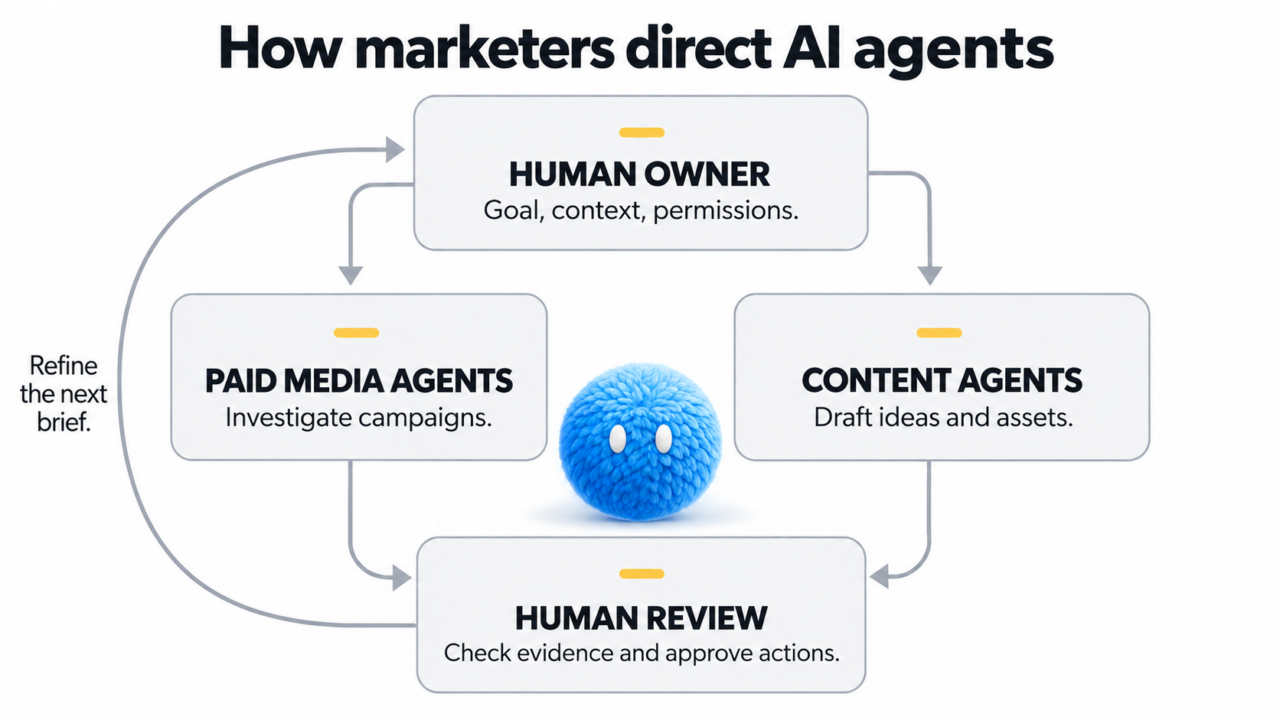
1. Turn objectives into specific assignments
“Improve campaign performance” leaves too much undefined. Instead, ask an agent to compare leads from different ads through attendance and paid conversion. Specify a consistent period and require it to show where outcomes are missing.
The marketer also decides when enough time has passed for a fair comparison. For example, last week’s leads cannot fairly be judged against older leads with months to progress. The brief should say when to return an incomplete answer or request more information.
2. Keep business context current
Connected information needs agreed definitions: what counts as a qualified lead, which offer a campaign promotes, and which claims the team can make. Therefore, shared context needs an owner and a review process.
If sales changes a qualification rule, someone must ensure that campaign analysis uses it consistently. Similarly, a new offer needs current pricing and approved claims. Feedback can update context or a workflow; storing it does not necessarily retrain the underlying model.
3. Set permissions and retain significant decisions
My rule is that actions with a significant impact on the brand or budget should require human approval. The person authorizing a spending change must be able to explain the evidence behind it. This is a recommended management rule, not a claim about a product’s default settings.
Lower-risk work, such as preparing an internal report, can run automatically after testing. However, permissions should match demonstrated reliability within a defined scope. The team also needs a clear way to stop a failing workflow.
4. Assess the quality of the work
Review each result against the original question. If a customer journey is incomplete, the agent should show that gap. Likewise, check whether the reason someone did not buy was recorded or inferred.
Consider a hypothetical recommendation to cut an ad’s budget because its leads miss more sales calls. First, compare booking delays and check missing attendance records. If those leads waited longer for appointments, faster follow-up may be the better test.
The marketer chooses the test and approves the action. Meanwhile, the agent supplies evidence and uncertainties.
Creative work needs the same discipline. The Ju and Aral experiment found that human–AI teams produced 50% more ads per worker. Their text was stronger, but images were weaker and outputs less varied. These results concern one task and system; volume alone did not establish better work across every measure. See the study’s findings and limitations.
“In the human-AI era, the scarce resource is sound judgment applied at the right points in the workflow.”
Jim Lecinski, clinical professor of marketing at Kellogg, writing in Think with Google.
How leaders should support changing marketing roles
Organizational change is already visible. BCG’s 2026 research draws on 300 CMOs, 50 interviews, and client observations. It describes new responsibilities for agent-assisted workflows and broader business objectives. However, reported practices do not mean every department has made the transition. Read BCG’s research on marketing transformation.
Some marketers now learn tools, build workflows, and help colleagues adopt AI while continuing to deliver campaigns. As a result, leaders need to update the job, including the work that leaves it.
If an agent gathers campaign data, make the supported investigation the deliverable. Requiring the marketer to recreate the old report consumes the capacity the team hoped to gain. Instead, focus verification on important claims and exceptions.
Develop AI marketing skills through real assignments
There is also a skills gap. Gartner’s 2026 survey of 401 marketing leaders found that 38% cited insufficient internal AI expertise and talent as a barrier to AI-driven efficiency. Most respondents represented companies with more than $1 billion in revenue, so smaller teams should assess their own needs. Read Gartner’s survey findings.
Useful AI marketing skills include writing clear briefs, checking evidence, recognizing data gaps, and knowing when to escalate. Give people time to practice those skills on a real assignment. Then put four things in writing:
- Delegated work: the recurring assignment and manual preparation it should replace.
- Decision ownership: who reviews findings, approves actions, and handles exceptions.
- Support: learning time and a named technical owner for integration problems.
- Evaluation: the business outcome, quality standard, and supervision effort.
There is no universal ratio of humans to agents. Expand delegated work while people can assess results and handle exceptions. A growing review backlog is a reason to improve the setup before adding assignments.
How to test AI agent management in your team
To test AI agent management in your team, start with a recurring question people already understand. First, record how the work happens today. Then agree on a trial period, quality standard, and human owner.
After the trial, evaluate the work using the same objective and quality standard. Track:
- Time to a supported decision: from the brief to an approved decision, including waiting and corrections.
- Usable output: the share of recommendations or assets that meet the standard, alongside the number completed.
- Business results: relevant outcomes, such as paid conversion or acquisition cost, considered alongside changes in spend and demand.
- Supervision: review time, rework, technical support, and unresolved exceptions.
A before-and-after comparison can guide the next trial, but other business changes can affect results. Therefore, distinguish an observed improvement from proof that the agent caused it. Expand when the team completes more useful work after supervision is accounted for.
How Nas.com supports teams working with AI marketing agents
At Nas.com, we build custom Nas agents around a company’s marketing work. Our engineers connect existing platforms, bring together business data and context, and deploy agents for specific workflows. The marketer then directs day-to-day work and oversees performance. Explore how Nas agents are deployed.
I would be skeptical of a plan to replace the entire marketing team with agents. The opportunity I see is a team where experienced people can ask better questions, direct more work, and develop their expertise through the results.
Their titles may look familiar. Their responsibilities need to reflect what the job has become.
Book a call with the Nas.com team to explore how custom agents could connect with your marketing tools and support the work your team needs to deliver.
Frequently asked questions
What is AI agent management?
AI agent management covers the goals, context, permissions, monitoring, and evaluation of agent work. For marketers, it means turning a business question into a clear assignment and reviewing the result. Technical owners support the connections and controls needed to deliver that work.
Is an AI agent manager a new marketing job?
It can be, but the responsibilities can also sit within an existing role. For example, a performance marketer can direct paid media agents while continuing to own campaign outcomes. The important change is a clear remit, training, and time for supervision.
How do you manage AI marketing agents?
Start with one recurring assignment. Define success, connect approved information, set action limits, and name a human reviewer. Next, test the output against known examples and record errors and review time. Expand the assignment only when the quality and workload justify it.
How is managing an agent different from prompting a chatbot?
A prompt asks for a response or task. Managing an agent also involves ongoing ownership, tool permissions, monitoring, and evaluation over time. Some chatbots can invoke agent capabilities, so check the actual workflow rather than relying on the interface’s label.
How many AI agents should one marketer manage?
There is no fixed number. The right workload depends on task risk, reliability, review time, and technical support. For example, a stable reporting task may require less attention than customer-facing creative. Use missed issues and review backlogs to decide when the workload is too large.