Quick Answer: How do AI agents generate leads?
AI agents for lead generation help teams find relevant prospects, check signs of need, research accounts and prepare useful outreach. Start with one customer problem and approved data sources. Then ask the agent to show its evidence, check the CRM and draft a message for human review. Measure qualified leads and revenue, rather than contacts collected or messages sent.
Better research comes before outreach
Two companies can use AI for lead generation and get completely different results.
For example, the first gives an agent a database of thousands of contacts and one instruction: book more meetings. The agent researches profiles, adds a line of personalization and produces more messages than the team ever could. It looks productive. Most of the outreach is still generic.
By contrast, the second asks an agent to look for people who are already showing signs of a real need: a founder asking for a recommendation, a CMO struggling with lead quality or a business searching for an alternative to its current provider. The agent checks whether each opportunity is relevant, gathers the necessary context and prepares a useful way to begin the conversation. A person decides whether to send it.
AI agents can make lead generation much better. They can also make it worse. The difference is whether they are being used to send more messages or help the team make better decisions before reaching out.
This guide explains how to use AI agents for lead generation in the second way.
How AI agents for lead generation improve prospecting
A lot of prospecting work happens before the first message is written. Someone has to find potential customers, check whether they are a good fit, understand what problem they may have and make sure nobody else on the team is already speaking with them.
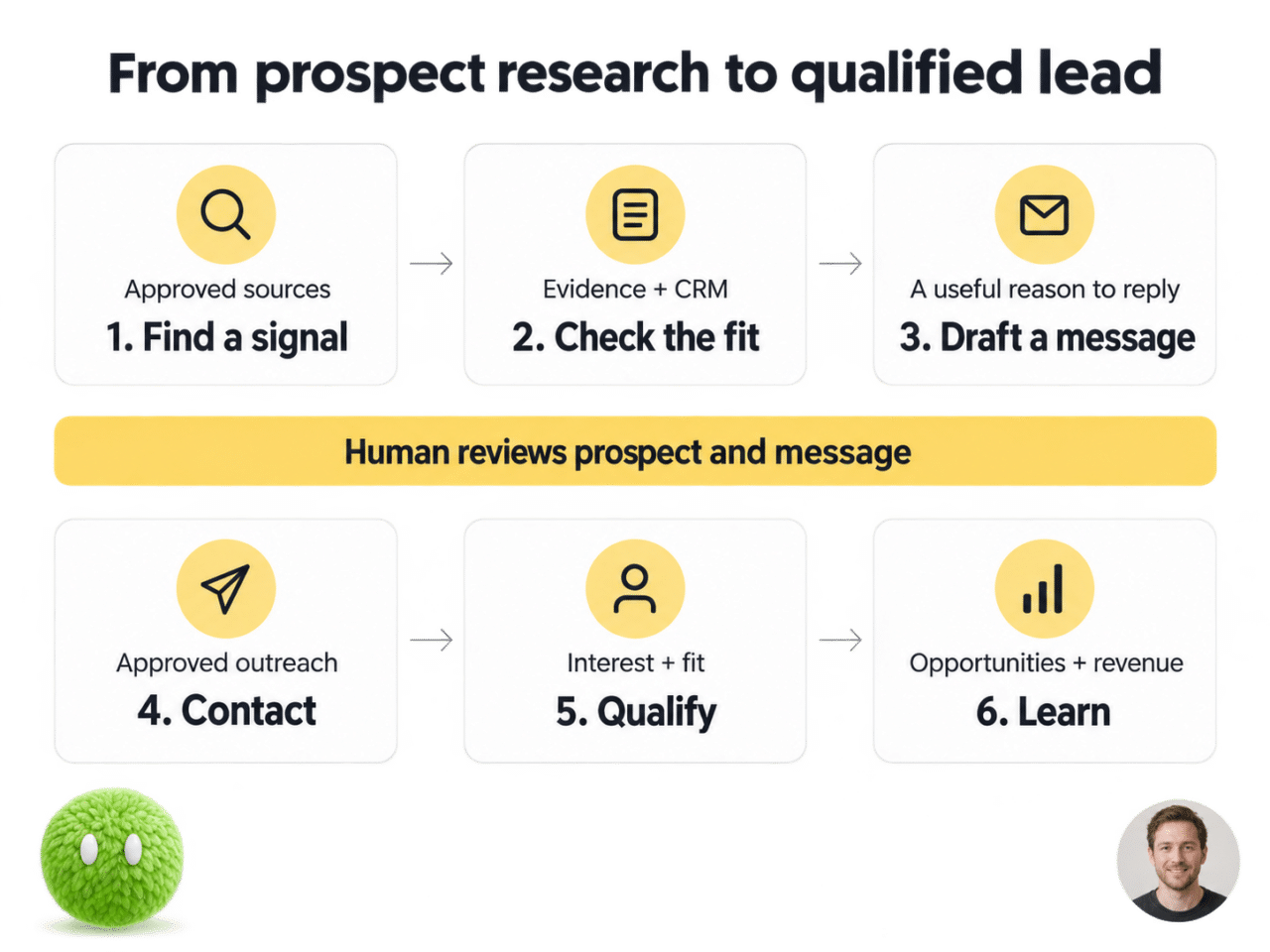
For example, an AI agent can handle much of this preparation. It can monitor approved sources for signs that someone may need what the company offers. Next, the agent can collect relevant public information and compare it with the company’s target customer. It should explain why the person may be worth contacting.
It can also check the company’s CRM to make sure nobody on the team is already speaking with the same prospect.
However, the agent does not have to send anything. It can give the sales or marketing team a smaller list of well-researched prospects. A person then decides whom to contact and approves the final message.
When an agent handles this responsibility regularly, using clear instructions and under human supervision, it can function as an AI employee.
A prospect is not the same as a lead
Teams use “prospect” and “lead” differently. For this guide, use the following working definitions so reporting stays consistent.
- A prospect is a person or company that appears worth contacting.
- A lead has shown interest in your company by replying, sharing their details, booking a call or taking another meaningful action.
Under these definitions, finding 500 people who match a customer profile means finding 500 prospects. It does not yet mean generating 500 leads.
As a result, this distinction keeps the reporting honest. The useful questions are how many prospects were worth contacting, how many showed interest, how many became real sales opportunities and how many eventually became customers.
How to use AI agents for lead generation: six steps
1. Tell the agent who is worth finding
“Find companies that need marketing help” is too vague. Almost any company could match that description.
Instead, write a short prospecting brief that answers three questions:
- What situation should the agent look for? For example, a marketing leader says that Meta’s cost per lead is falling but the sales team is receiving poor-quality leads.
- How can the company genuinely help? For example, it can review the connection between the ads, landing page, lead form and sales qualification process.
- Who is not a good fit? This may include job seekers, students, agencies looking for subcontractors or companies outside the markets the business serves.
In other words, the agent is not simply searching for the words “Meta ads.” Those words could appear in a tutorial, a job post or a conversation that has nothing to do with buying. It is looking for a specific business problem expressed by the kind of customer the company can help.
2. Look for signs that someone needs help now
Most prospect lists are built around fit: industry, company size, location, job title or revenue. These details can tell you whether a company resembles your usual customer. They cannot tell you whether the company needs help today.
For example, timing can come from a new marketing leader, a product launch, a round of hiring, an expansion or a visible change in advertising. It can also come from something much more direct: a person publicly talking about a problem they are trying to solve.
They may be:
- Asking for a recommendation
- Comparing two products or approaches
- Looking for an alternative to their current provider
- Describing a campaign or process that is not working
- Complaining about an issue that your company knows how to solve
However, a company may be a perfect fit on paper and still have no reason to speak with you. A current problem gives the outreach a real purpose.
Also, the agent should only use sources and access methods that the company is allowed to use. Information being publicly visible does not automatically make every form of collection or outreach appropriate.
3. Check whether the prospect is actually worth contacting
When the agent finds a possible prospect, it should answer a few basic questions before suggesting outreach:
- Is the post, comment or business change recent enough to matter?
- Does this prospect match the customers the company normally serves?
- Can the company help solve the problem this person describes?
- Check whether anyone on the team is already speaking with them.
- Confirm that a suitable, permitted contact channel exists.
Therefore, the team should see the original source, the date and a short explanation of why the prospect was selected. If the agent cannot explain why someone is relevant, that person should not be added to the list.
4. Give the prospect a clear reason to reply
Once the agent finds the right person, the next question is: why would that person reply?
A weak message might say:
Although the message uses Sarah’s name and mentions her post, it does not offer anything useful.
A better message responds to the problem she actually described:
As a result, this gives Sarah a reason to respond because it shows that the company understood her problem and can offer a useful next step. The agent can prepare this first draft using verified information. A person should then check the advice and approve the message before anything is sent.
5. Keep a person in control of outreach
The agent can prepare the research and draft a message. A person should still decide whether the message deserves to be sent.
Before approving it, the reviewer should ask:
- Have we understood the prospect’s problem correctly?
- Is our offer genuinely relevant?
- Does the message contain any claim or promise we cannot support?
- Would this feel helpful if somebody sent it to us?
- Is this the right channel and the right time?
In turn, this review protects the company’s reputation. It also shows where the agent’s research or judgment still falls short.
6. Record what happened and improve the process
Next, the research, outreach and sales outcome need to stay connected. Otherwise, the marketing team sees which messages received replies but never learns which prospects became customers.
A simple pipeline could be:
Prospect → Contacted → Interested lead → Qualified lead → Sales opportunity → Won
Also, for each prospect, record where they were found, what problem they appeared to have, why the team contacted them, what was sent and what happened next.
Over time, this shows which sources produce good prospects, which signs of need lead to real conversations and which offers attract the right customers. The team can then improve the prospecting brief instead of simply sending more messages.
Where AI lead generation saves time
Of course, the sales or marketing team could do all of this research manually. The difficulty is doing it consistently while also running campaigns, speaking with customers and closing sales.
For example, an agent can monitor relevant sources, collect context, check the CRM, remove poor matches and prepare a first draft. Instead of handing the team another large database, it gives them a shorter list of prospects with a clear reason behind each recommendation.
After outreach, it can also help record routine responses and move interested prospects to the right person. Complicated, sensitive or negative replies should go directly to a human.
These responsibilities work best within a clear AI marketing team structure. For example, the agent can prepare research while a marketer owns targeting and a sales rep handles the conversation.
What people should still control
Although an agent can reduce the repetitive work, people remain responsible for decisions that affect a potential customer.
The team should still control:
- Which customers the company wants to attract
- What the company offers and promises
- Whether a prospect should be contacted
- The final message in important conversations
- Pricing, negotiation and commercial commitments
- Sensitive or negative responses
- The standard used to judge the agent’s work
However, the team should also examine incorrect recommendations, not only the successful ones. If the agent keeps finding the wrong people, rewriting the outreach will not solve the problem. The prospecting brief, the sources being monitored or the selection rules need to change.
How to measure AI lead generation quality
When using AI agents for lead generation, message count shows activity rather than business value. Instead, track whether the process finds good opportunities.
Useful measures include:
Therefore, meeting count matters only if the meetings are with the right people. A calendar full of poor-fit meetings wastes the sales team’s time.
Five ways AI lead generation goes wrong
Starting with a huge list of prospects
A list of 10,000 prospects may look impressive, but it does not tell the team who needs help now or why they would want to speak with the company.
Instead, start by defining one problem the company solves well. Give the agent a narrow brief and test whether it can consistently find people who are experiencing that problem. More prospects are useful only after the selection process works.
Mistaking a keyword for genuine interest
Suppose the agent finds a post containing the phrase “Meta ads.” The writer could be teaching a course, applying for a job, sharing industry news or asking for help with a failing campaign. Only the last situation may indicate a relevant need.
Therefore, the agent needs to understand the surrounding conversation. Before recommending the person, it should be able to explain what problem they appear to have and why the company may be able to help.
Inventing personal details
For example, AI can fill missing information with a confident guess. A message may sound highly personalized while referring to a campaign the prospect never ran or a business priority they never mentioned.
Therefore, outreach should use verified information and approved claims. When the evidence is limited, the message should acknowledge that instead of pretending the company knows more than it does.
Automating outreach before the research is reliable
If the research is weak, automatic sending spreads the same mistake to more people, faster. Begin with the agent recommending prospects and drafting messages for review. Give it more freedom only after the team trusts the quality of its work.
Also, companies need to respect the rules of every source and channel they use. LinkedIn does not permit third-party tools that scrape or automate activity on its website. Commercial email carries legal responsibilities too. In the United States, the CAN-SPAM Act sets requirements for commercial messages and gives recipients the right to stop future email. Other countries have their own privacy and marketing rules.
Counting activity without learning from the result
If the team tracks only prospects found and messages sent, the agent has no way to distinguish a busy campaign from a useful one.
Instead, connect the process to replies, qualified leads, sales opportunities and revenue. That is how the team learns whether a particular source or type of problem is producing good customers.
How to start using AI agents for lead generation
Start using AI agents for lead generation with one narrow prospecting task. Then expand only when the team can verify the quality.
- Choose one customer problem the company understands well.
- Write down how a potential customer might describe that problem.
- Choose one or two appropriate sources to monitor.
- Define who should not be included.
- Decide what information the agent must provide with every suggested prospect.
- Decide what useful observation or resource it may prepare.
- Assign a person to review every prospect and message.
- Record what happens after outreach, including qualified leads and revenue.
At first, let your AI lead generation agent recommend prospects and draft messages without sending anything. Review both the good and bad suggestions. Add more sources or permissions only after the team trusts its recommendations.
Frequently asked questions
Can AI agents generate leads automatically?
They can find prospects, research them, prepare outreach, sort responses and update a CRM. A prospect becomes a lead only after showing interest in the company. A person should review important outreach, especially while the process is still being tested.
What is the difference between an AI lead-generation agent and automation?
Traditional automation follows a fixed set of steps. An AI agent can examine different types of information, compare them with the company’s instructions and recommend what should happen next. A reliable system often uses both: an agent for work that requires judgment and fixed automation for predictable tasks.
What information can a lead-generation agent use?
It may use approved public sources, company information, CRM records and licensed data providers. The exact sources depend on the business, local law, platform rules and the permissions the company has received. Information being public does not automatically make every use appropriate.
Should an AI agent send cold outreach?
Some systems can, but automatic sending should not be the starting point. Begin by using the agent for research, selection and drafting. A person should decide what gets sent until the team knows the process is reliable, compliant and suitable for the relationship.
Can small businesses use AI agents for lead generation?
Yes. A small business can begin with an agent that monitors one source, researches potential customers or prepares first drafts. The business still needs a clear target customer, a relevant offer and someone who can speak with interested prospects.
How should an AI lead-generation agent be measured?
Measure the quality of the prospects it recommends, the team’s approval rate, positive responses, qualified leads, sales opportunities and revenue. Do not judge it mainly by the number of contacts collected or messages produced.
The goal is a better conversation
Lead generation rarely fails because a company cannot find enough names. It fails because the people receiving the outreach have no clear reason to care.
AI can magnify either side of that problem. Give an agent a large list and a meeting target, and it can produce more unwanted messages. Give it a specific problem to watch for, clear boundaries and a human reviewer, and it can help the team recognize opportunities they might otherwise miss.
Meanwhile, people still speak with customers, build relationships and decide what the company can promise. The agent helps them prepare by doing the research first.
For most teams, that is the more valuable outcome: not 500 new names in a spreadsheet, but a small number of timely conversations with people the company may genuinely be able to help.