Quick Answer: How can AI turn more inquiries into booked jobs?
AI can improve home service marketing by helping teams respond to inquiries, qualify requests, prepare booking options and follow up on estimates. First, give the agent accurate service rules and access to the real schedule. Then connect completed jobs back to their marketing source. Keep a dispatcher or business owner responsible for urgent cases, complex estimates and decisions outside the agent’s limits.
Why good leads never become booked jobs
At 8:30 p.m., a homeowner notices water spreading across the kitchen ceiling. They search for an emergency plumber, click a local company’s ad and call.
Nobody answers, so they complete the website form. Ten minutes later, the phone is still silent. They call another plumber, who answers and confirms an emergency visit.
Now imagine the same evening with an AI agent watching the first company’s forms. It sends an approved acknowledgment and asks for the ZIP code and a short description. Then it checks the service area and alerts the on-call dispatcher. The dispatcher confirms the available time and books the visit.
The agent does not diagnose the leak. Instead, it keeps the request moving toward a person who can help.
Both versions start with the same lead. However, only the second company responds while the homeowner still needs help. This is where home service marketing and day-to-day operations meet.
The agent also needs the company’s rules to make that response useful. Someone must define which areas it serves, which details to collect and who handles urgent work.
How AI supports the home service marketing workflow
Before an agent can help, define four things: a trigger, approved business information, a permitted action and a human owner.
In the plumbing example, the website form is the trigger. Service-area rules provide context, while the approved acknowledgment is the action. The dispatcher remains responsible for confirming the urgent visit.
The same pattern works across qualification, booking, estimates and completed-job reporting. For example, an agent can prepare options while a person handles exceptions.
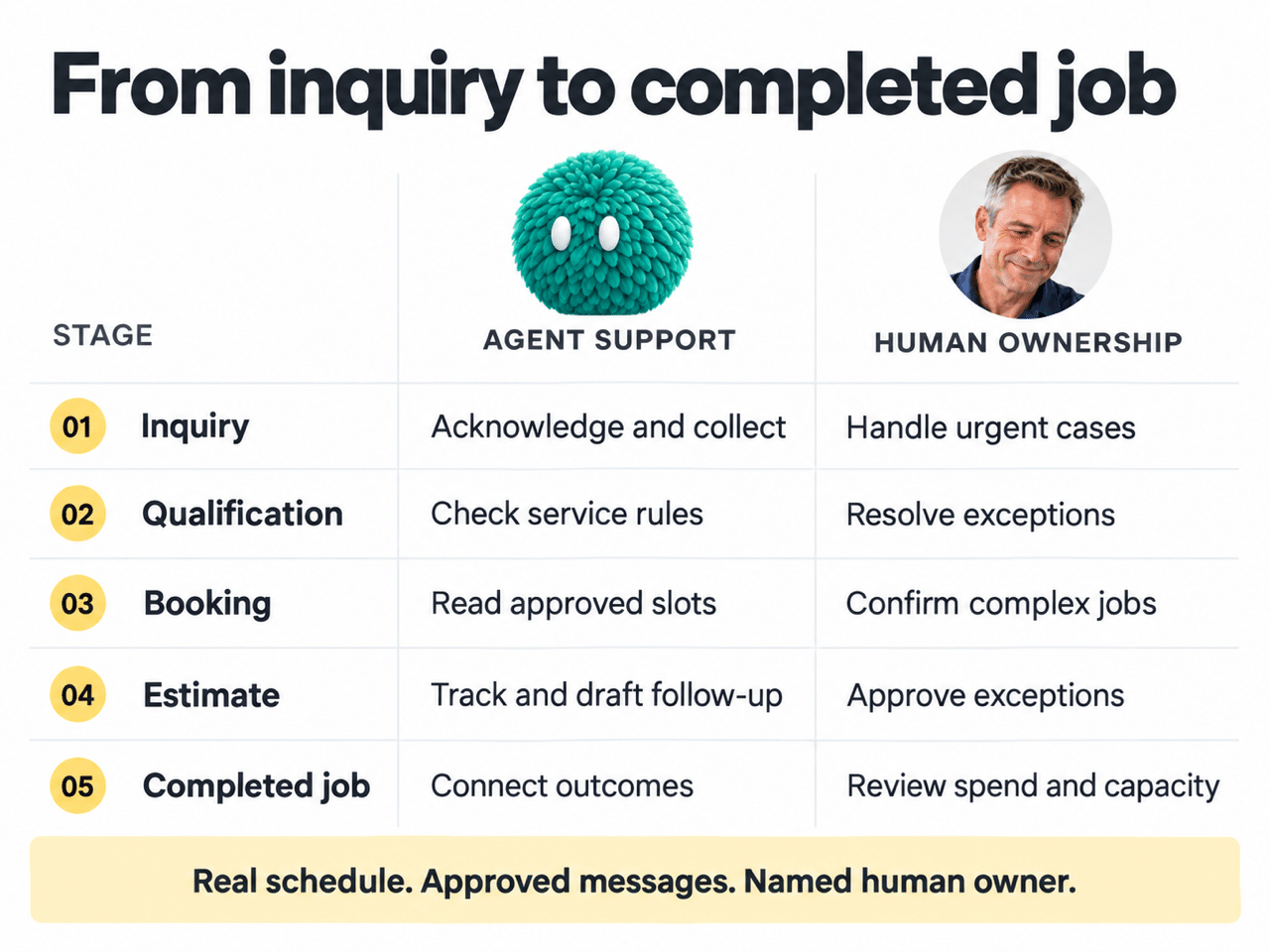
The diagram shows responsibilities across the customer journey. Next, use the six steps below to build the process around your own business.
Step 1: Find where leads stop moving
Start with inquiries from the last few weeks. Review call logs, forms, messages, CRM records and the booking system. You do not need a perfect dashboard to identify the first gap.
For each inquiry, ask where it stopped and who owned the next step. Then look for a pattern.
Choose a gap that is costing meaningful work and has clear rules. For example, after-hours forms may be a better first project than automating every customer conversation.
Your home service marketing may still need more demand. However, first check whether the team is losing suitable leads it already has.
Step 2: Give the agent your business rules
An AI model may know what plumbers, electricians and roofers generally do. It does not automatically know how your company operates.
Therefore, give the agent accurate information about:
- Services you offer and work you do not accept.
- ZIP codes, cities and neighborhoods each crew covers.
- Opening hours and after-hours coverage.
- Urgent jobs, scheduled visits and estimate-led work.
- Required technician skills, licenses and equipment.
- Membership, warranty and existing-customer rules.
- The person responsible for each type of request.
Google’s service-area guidance recommends accurate coverage information. Use the same approved areas in your intake workflow so the agent does not accept work your dispatcher must reject.
Also separate what the customer says from what the agent infers. “The customer reports water below the sink” is useful context. “The pipe needs replacing” is an unverified diagnosis.
Once those rules are clear, the agent can continue intake, explain that the company is not a fit, or hand the request to a person.
Step 3: Respond while the customer still needs help
Home service marketing creates an opportunity when someone calls or submits a form. AI lead response helps the team act on that opportunity before the request sits unanswered.
For a new inquiry, define a short sequence:
- Confirm that you received the request.
- Collect only what is needed for the next decision.
- Check the details against approved service rules.
- Explain what will happen next.
- Alert a person when the request is urgent, unusual or outside the agent’s authority.
For example, intake might include the address, service needed, when the issue began and preferred times. An HVAC request may also need relevant equipment details. Ask for photos only when they help the next decision.
Google’s Local Services Ads guidance recommends responding promptly. It also explains that messaging response estimates may appear on ads and that quick replies can encourage engagement.
The first exchange should end with enough information to move toward booking, or a clear handoff. An acknowledgment alone should not count as a resolved inquiry.
Where an AI receptionist fits
An AI receptionist can support calls or messages when it has the right connections and instructions. However, answering is only one part of the job. It also needs a reliable route to the dispatcher and a clear boundary around what it can promise.
Step 4: Connect the agent to the real schedule
A quick response helps only if it leads to a real next step. Therefore, connect the agent to approved availability in your booking or field-service system.
An empty calendar slot does not always mean you can take the job. The visit may depend on technician skills, equipment, travel time, duration and existing commitments.
Use the live system as the source of truth. A separate AI-maintained calendar can create conflicting promises.
Routine, well-defined jobs
The agent may offer suitable slots if the company permits it. It should check the service area, job type and current availability before making an offer.
Then confirm the booking in the real system so another person cannot offer the same time.
Complex or uncertain jobs
If the work has an uncertain duration, high value or safety concern, collect the customer’s preferences.
Next, send the complete request to a dispatcher, estimator or qualified technician for review.
The handoff should include the information already collected and why a person is needed. As a result, the customer does not have to repeat the story.
Also confirm that a named person owns the request. Sending a summary to an unmonitored inbox recreates the original problem.
Step 5: Follow up on estimates and unbooked inquiries
Not every inquiry should become a booking during the first conversation. For example, a roof replacement or HVAC installation may require an inspection, an estimate and time to decide.
Home service marketing automation can help the team track those open opportunities. An agent can watch status changes, remind the owner and prepare a follow-up based on the latest conversation.
Where the customer has agreed to receive a message, the agent can send approved follow-up within its limits. Each message should have a reason:
- Did the customer receive the estimate?
- Do they need an option explained?
- Are they waiting for insurance or financing?
- Would they like to choose a date?
Instead of repeating “just checking in,” use the earlier exchange and current status. Stop when the customer declines, chooses another provider or asks not to be contacted.
This workflow suits considered purchases. By contrast, the urgent plumbing inquiry at the start needs an immediate handoff, not a slow estimate follow-up sequence.
Step 6: Connect completed jobs to home service marketing
If you measure only calls and forms, you cannot tell which campaigns create useful work. Connect each inquiry to later outcomes wherever the records support it.
- Qualified or not qualified.
- Booked or not booked.
- Completed or canceled.
- Service performed.
- Revenue collected.
- Location or branch.
First, use the CRM or field-service system to connect those outcomes internally. Then decide which permitted events to share with advertising platforms.
Use completed-job data in campaign measurement
Google’s enhanced conversions for leads can help connect later CRM outcomes to ad interactions. With the right setup, reporting can distinguish a form submission from a lead that became a customer.
However, internal records are not automatically suitable for upload. Follow Google’s customer data policies, including applicable disclosure and consent requirements. Share approved measurement fields rather than entire customer conversations.
Once the data is reliable, an agent can flag questions that matter to home service marketing:
- Which campaigns produce booked and completed jobs?
- Which search terms bring genuine work rather than wrong-number calls?
- Which services justify their acquisition cost?
- Which locations can crews serve efficiently?
- Where do suitable leads disappear after first contact?
Match demand to crew capacity
Suppose a plumbing campaign keeps generating urgent requests while the relevant crews are fully booked. More leads may create frustration rather than revenue.
Instead, an agent can flag the mismatch and recommend reducing or pausing that campaign. A person reviews meaningful budget changes before they happen.
This connects marketing decisions to actual capacity. For a related example, see how a Meta Ads AI agent monitors campaigns.
Use completed jobs to support reviews and repeat work
Completed visits can also lead to reviews, repeat work and referrals. Google allows requests for genuine customer reviews, but prohibits incentives for reviews or changes to them.
A reputation agent can monitor feedback, identify recurring issues and prepare replies. For complaints or disputes, a person should review the context and decide what to say.
Define when a person must take over
AI marketing for home services works best when authority is explicit. Before launch, decide which actions can happen automatically and which require approval.
For each action, choose one level:
Automatic within approved rules
For example, acknowledge a form, collect basic details or remind an internal owner. Keep the task narrow and the inputs approved.
Prepare for approval
The agent can draft a response, suggest a scheduling option or recommend a campaign change. A person checks it before execution.
Hand off immediately
Send urgent, unsafe or unusual requests to the right person with the conversation and a clear reason for escalation.
A person should handle possible safety risks, serious complaints, complex estimates and exceptions to pricing or warranty rules. The same applies to promises the agent cannot verify and customers who are distressed or struggling to explain the problem.
Handing off does not stop the agent from helping. It can still summarize the request and prepare the relevant records. However, a person owns the judgment and final decision.
Measure bookings and completed jobs, not just lead volume
A home service marketing dashboard should show what happens after first contact. Start with a small set of measures that connect response, booking and completed work.
Response and handoff
Track time to a useful response, unanswered inquiries and how long escalations wait for a human owner.
Also review cases where customers repeat information or receive an incorrect promise.
Booking and completion
Measure booked jobs as a share of suitable inquiries. Then track which bookings become completed visits and collected revenue.
Compare the same job types and time periods so seasonal demand does not obscure the result.
For example, cost per completed job is campaign spend divided by the completed jobs attributed to that campaign. Use a consistent attribution method and allow time for recent leads to become jobs.
Include the time people spend reviewing or correcting agent work. Otherwise, a faster first reply can hide extra work for the dispatcher.
No single number tells the whole story. Lead volume measures demand, while booking rate, completed jobs, revenue and margin show whether that demand helps the business.
Start with one gap in your home service marketing
Return to the homeowner with water coming through the ceiling. They need a clear next step, not an impressive AI conversation.
Start with one place where customers are being left waiting. For example, an after-hours web form is enough for a first pilot: acknowledge it, collect basic details and alert the on-call person.
Before launch, record the current response and booking process. Then review how the agent handles real requests, including missing information and exceptions.
Once that works reliably, consider giving it permission to prepare times or send further approved messages. Keep each expansion tied to evidence from the previous step.
The team should feel the benefit too. Requests arrive with useful context, someone clearly owns them, and customers repeat less information. After the visit, home service marketing can see whether the lead became real work.
This is one example of how AI is changing marketing: people set the goals and limits, while agents help recurring work move forward.
Frequently asked questions
How can AI improve home service marketing?
AI can help teams respond to inquiries, collect details, route requests, follow up on estimates and connect completed jobs to campaigns. Start with one clear gap so you can measure whether more suitable leads become booked work.
Can an AI receptionist answer calls and book appointments?
Yes, with suitable phone or messaging connections, accurate service rules and approved scheduling access. However, define which jobs it may book and which need a dispatcher or technician. Complex quotes, safety concerns and exceptions should go to a person.
What details are needed to qualify a home-service lead?
Common details include the requested service, address or ZIP code, urgency, property type and preferred times. Relevant photos or equipment details may also help. Ask only for information needed for the next decision.
What is the best home service marketing metric?
Use several connected measures. Cost per lead shows how efficiently campaigns create inquiries, while booking rate and completed jobs show what happens next. Also review collected revenue, profitability and human review time.
Where should a home-service business start with AI agents?
Choose a recurring problem with clear rules and a measurable result. For example, start with after-hours forms, missed-call follow-up or open-estimate reminders. Keep a named human owner and expand the agent’s authority gradually.