
Quick Answer: How is AI changing marketing?
AI is changing marketing in 2026 by moving more product research, comparisons and campaign work to AI assistants. Marketers need to build human trust and provide clear facts that agents can check. Search, ads, email, websites, content and brand still matter. However, the buyer journey and the work behind each channel are changing.
For the last 20 years, marketing has largely followed one playbook: get someone’s attention, earn their trust and help them buy. SEO, paid ads, email and landing pages all serve that goal.
I think that playbook is entering a new phase. Humans still make choices, but AI can now do more of the research that shapes those choices. As a result, brands may enter a shortlist before a buyer ever visits their site.
This is how AI is changing marketing beyond faster copy and cheaper creative. The bigger shift is who gathers the evidence, compares the options and decides what deserves attention.
The buyer journey now includes AI assistants
Imagine shopping for running shoes. In the past, you might open a dozen tabs, watch reviews and compare prices. Now, you can start with a much more specific request.
The research still happens. However, an assistant can collect some of the information and present a shortlist. You can then check the details, try the shoes and choose what works for you.
This shift already has a foundation. In March 2026, OpenAI described product discovery in ChatGPT, including visual browsing and side-by-side comparisons. Earlier that year, Google introduced the Universal Commerce Protocol for agent-assisted commerce across discovery, buying and post-purchase support.
These examples show a direction of travel. They do not mean every buyer has delegated every purchase. My view is that more research will move to agents, while people retain different levels of control.
The funnel still happens. Your website may see only part of it.
How AI is changing marketing across six channels
The useful question is what your team should do differently. These six AI marketing trends connect the changing buyer journey to decisions marketers already own.
1. Search expands from rankings to recommendations
A search result gives people places to explore. An AI answer can also compare choices against a detailed brief. Therefore, visibility increasingly depends on whether your product is easy to understand and support with evidence.
For example, a buyer might want a CRM for a 50-person services business. They need Slack integration, a clear migration path and an annual budget under $30,000. A page that only says “the best CRM” does little to answer those needs.
Instead, explain who the product serves, what it costs and where its limits are. Add accurate integration details, customer examples and useful comparisons. Answer engine optimization, or AEO, starts with that clarity.
However, this does not require a secret formula. Google’s guidance for AI search features says established SEO practices still apply. Helpful content, crawlable pages and clear internal links remain useful; no special AI markup guarantees inclusion.
2. Paid ads respond to more specific intent
AI is changing marketing in paid channels by connecting messages more closely to a person’s request. For example, one shopper may care about a running shoe’s durability. Another may care about its weight or price.
In May 2026, Google announced tests of new AI search ad formats. These included ads designed to answer specific questions and explain product fit. Availability varies, so treat each platform’s rollout separately.
The strategic work still belongs to marketers. You define the customer, offer, brand voice and claims the business can support. You also decide which outcomes count as success.
As automation expands, strong inputs become more valuable. Give the system useful creative options and reliable conversion signals. Then judge the result by qualified demand and revenue, alongside cost and volume.
3. Email must earn attention through another filter
My expectation is that more customers will use AI to summarize and sort their inboxes. If that happens, your message must make sense both to the reader and to the assistant helping them prioritize.
Consider a renewal email. “Your plan renews on October 1 at $49” gives the reader a useful fact. A vague subject line and three paragraphs of buildup make that fact harder to find.
On the company side, an email agent can support approved triggers, drafts and follow-up tasks. However, the team still owns consent, contact frequency, offers and tone. Those decisions shape the customer relationship.
4. Websites serve humans and machines
People need a site that builds confidence and makes the next step easy. Meanwhile, AI assistants need facts they can interpret and compare. Good website design should support both.
Start with consistent pricing, features, availability and policies. For instance, an old price in your FAQ can undermine a current offer on your product page. Your sales team may notice the same conflict.
Product feeds are another part of this work. OpenAI’s product feed specification includes fields for product descriptions, images, prices and availability. Accurate data helps represent an offer clearly; it does not promise a recommendation.
Also keep key information in readable text. Where you use structured data, make sure it agrees with the visible page. The aim is a reliable source of truth that works for people and supported discovery systems.
5. Content becomes a library of evidence
A blog post can do more than bring traffic. It can explain a method, show a tradeoff or document a result. Similarly, a customer story can help someone judge whether your product fits their situation.
That changes what deserves investment. Original research, expert experience and specific examples give readers something they cannot get from a generic summary. They also provide evidence that discovery systems may surface.
AI can help turn an interview into a draft or repurpose a useful explanation. However, it cannot supply a real customer result your business has never achieved. People still need to contribute the experience and verify the claims.
6. Brand helps people choose among similar options
AI is changing marketing, but it does not erase human preference. A shortlist can narrow the options. People may still choose the brand they trust, identify with or simply enjoy.
My view is that brand becomes more valuable as comparisons get easier. When several products meet the brief, a distinct point of view gives people a reason to care.
Of course, preference cannot fix a poor experience. Product quality, service and reliable claims must support the story. The strongest brand work connects what you promise with what customers actually receive.
Two audiences, one buying decision
Marketing to AI agents means helping assistants understand and assess your offer on a person’s behalf. It does not mean abandoning the person behind the request.
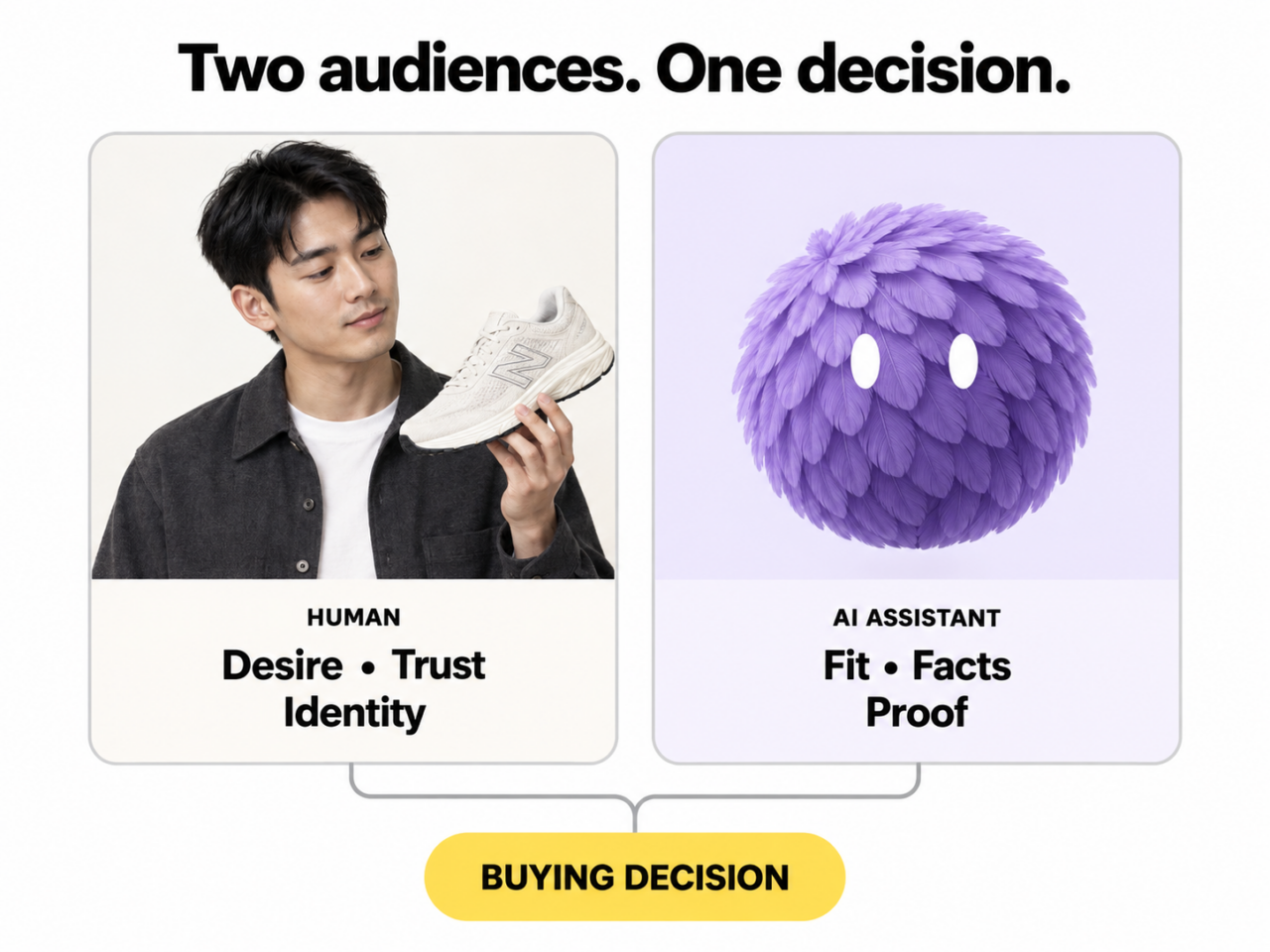
For the human: make me want you
Build desire, trust and a sense of fit. Stories, design, customer experience and a clear point of view help people form a preference.
For the assistant: help me assess you
Provide accurate prices, features, compatibility and proof. Also make your limits clear, so the assistant can compare the offer against the buyer’s needs.
These needs overlap. Humans want facts, too, and assistants may consider the preferences people express. Therefore, build one consistent story with enough evidence to support it.
AI is changing marketing work into a continuous loop
The customer journey is only half the story. Inside the business, AI agents can help teams notice changes and act on them sooner. That shifts some work from scheduled reporting toward an ongoing feedback loop.
See
Collect agreed signals from ads, CRM records, email and customer feedback. First, check that the data is complete enough to use.
Investigate
Compare results and look for possible causes. For example, higher lead costs may reflect weaker conversion, a changed audience or missing tracking.
Judge
Decide whether to act. Humans set priorities, weigh uncertainty and approve changes that affect budgets, promises or customer trust.
Act
Let agents carry out tested, repeatable tasks within clear limits. Route exceptions to the person responsible.
Learn
Record what changed and what happened next. Then use that evidence to improve the next brief, test or decision.
The right cadence depends on the business. A daily check may be enough for one workflow, while another needs faster alerts. In both cases, speed only helps when the signals and decisions are sound.
Which agents does a marketing team need?
If customers use assistants to compare options, companies need a better way to maintain their own marketing evidence and operations. That does not require launching every agent at once.
Start with a recurring acquisition problem. Then give each workflow a clear purpose, data access and human owner. The following are roles to configure and test; specific capabilities depend on the tools and integrations you use.
Meta Ads Agent
Track spend, creative results and lead quality together. For example, 100 leads that produce five customers tell a different story from 100 unqualified leads.
Use the findings to propose a creative test or budget change. A marketer approves the strategy and spending limits.
Google Ads Agent
Review search terms and connect intent to qualified outcomes. Then flag wasted spend, useful exclusions and landing-page gaps.
Humans still choose the markets, customer segments and promises the business should pursue.
Content Agent
Bring audience questions and campaign feedback into the next brief. It can also draft variations from approved facts and assets.
However, people own the point of view, original reporting and final claims. That keeps faster production tied to useful content.
Email Agent
Support lifecycle triggers, drafts and follow-up tasks using relevant, permitted data. For instance, it might flag a stalled onboarding step.
The lifecycle owner sets the message, consent rules and frequency limits before automation runs.
Reputation Agent
Monitor accessible reviews and public feedback for recurring issues. Next, summarize the evidence and draft a response for review.
People handle sensitive situations and decide how the company should respond. Customer feedback should also reach the teams that can fix the problem.
Reporting Agent
Connect channel activity with qualified demand and revenue. Also flag data gaps, so a neat dashboard does not hide a broken measurement process.
Use attribution as a guide to investigation. It does not, by itself, prove that a campaign caused a sale.
For a deeper channel example, read what a Meta Ads AI agent can automate. Our AI marketing team structure guide maps the wider division of work between humans and agents.
The Company Brain connects acquisition knowledge
The Company Brain gives agents shared customer acquisition context: who you want to reach, which offers work and which campaigns bring qualified customers. It connects that knowledge with CRM outcomes, revenue data and brand rules.
As a result, teams can assess channel results against the same business goals. A cheap lead should not count as a win if it rarely becomes a customer.
However, shared context needs maintenance. Define who owns each source, how often it updates and which agents can access it. Keep a record of important changes and lessons from tests.
What marketers should do next
AI is changing marketing at different speeds across channels. Therefore, the best next step is a focused experiment with a clear owner and outcome.
- Choose one buying journey. Write down the questions customers ask before they buy.
- Strengthen the evidence. Update product facts, pricing, comparisons and customer examples.
- Test one agent workflow. Start with monitoring or recommendations before granting permission to act.
- Connect the outcome. Review qualified leads, customers or revenue alongside clicks and traffic.
- Keep the human judgment. Review what the system missed and improve the rules.
The future of marketing will still reward teams that understand people. My bet is that those teams will also learn to make their value clear to the agents helping people choose.
For practical setup ideas, explore AI marketing automation for small businesses.
Frequently asked questions
How is AI changing marketing in 2026?
AI is changing marketing by helping buyers research products and helping teams automate recurring work. As a result, marketers need clear product evidence, useful content and reliable customer data. Humans still set the strategy and judge important decisions.
What does marketing to AI agents mean?
It means making your offer easy for assistants to understand, check and compare. For example, publish accurate prices, features and limits. Support claims with evidence while keeping the experience useful for human buyers.
Will AI replace search, ads and email?
These channels still serve customer needs. However, AI can change how people discover and assess information within them. Teams should test the changes that affect their audience instead of assuming every channel will disappear.
Why does brand still matter?
People bring trust, taste and preferences to a purchase. Therefore, a shortlist does not remove the value of a distinct brand. The promise also needs support from the product and customer experience.
Why do marketing teams need AI agents?
Agents can help teams monitor more signals and complete repeatable tasks. However, start with a specific problem and measure the benefit. A well-run workflow matters more than the number of agents you deploy.