Quick Answer: Why does distribution matter more with AI?
A distribution strategy is how a business helps the right customers discover, trust and choose its product. AI makes products and marketing faster to create, so more companies can compete for the same attention. As a result, marketers need a clear offer, credible proof, useful follow-up and channels that learn from one another. AI agents can support this work; people still own the promise and the customer relationship.
For years, building was the hard part. A founder could have a strong idea and still spend months getting it into a customer’s hands. The product needed engineers. The website needed design and development. Meanwhile, the campaign needed research, copy and production before the market could respond.
AI has shortened that path. However, the same tools are available to competitors. A strong distribution strategy matters more when many teams can create a credible first version quickly. The harder advantage becomes earning attention, keeping trust and turning interest into customers.
Building became easier. Being chosen did not.
Why AI makes distribution more valuable
Software and creative production show the change clearly. For example, OpenAI’s 2026 introduction of the Codex app described people supervising several coding agents across the software lifecycle. That gives capable teams more building capacity, while people still review and direct the work.
Similarly, Adobe reported in April 2025 that creators had generated more than 22 billion assets with Firefly. Images and videos are part of a much larger increase in what small teams can produce.
These tools do not remove the need for engineers, designers or marketers. Instead, they shorten the path from an idea to something a customer can see. Across a market, that creates more supply.
More supply competes for the same attention
Customers do not gain more time when companies produce faster. They see more products, landing pages, ads and emails making similar promises. Therefore, a team that uses AI only to publish more may simply add to the noise.
Speed can help, but competitors can adopt the same tools. By contrast, customer knowledge, trusted relationships and evidence of real results take time to build. A distribution strategy should invest in those advantages as well as production speed.
This is one part of how AI is changing marketing: the work shifts toward understanding buyers and helping them make a confident choice.
What a distribution strategy includes
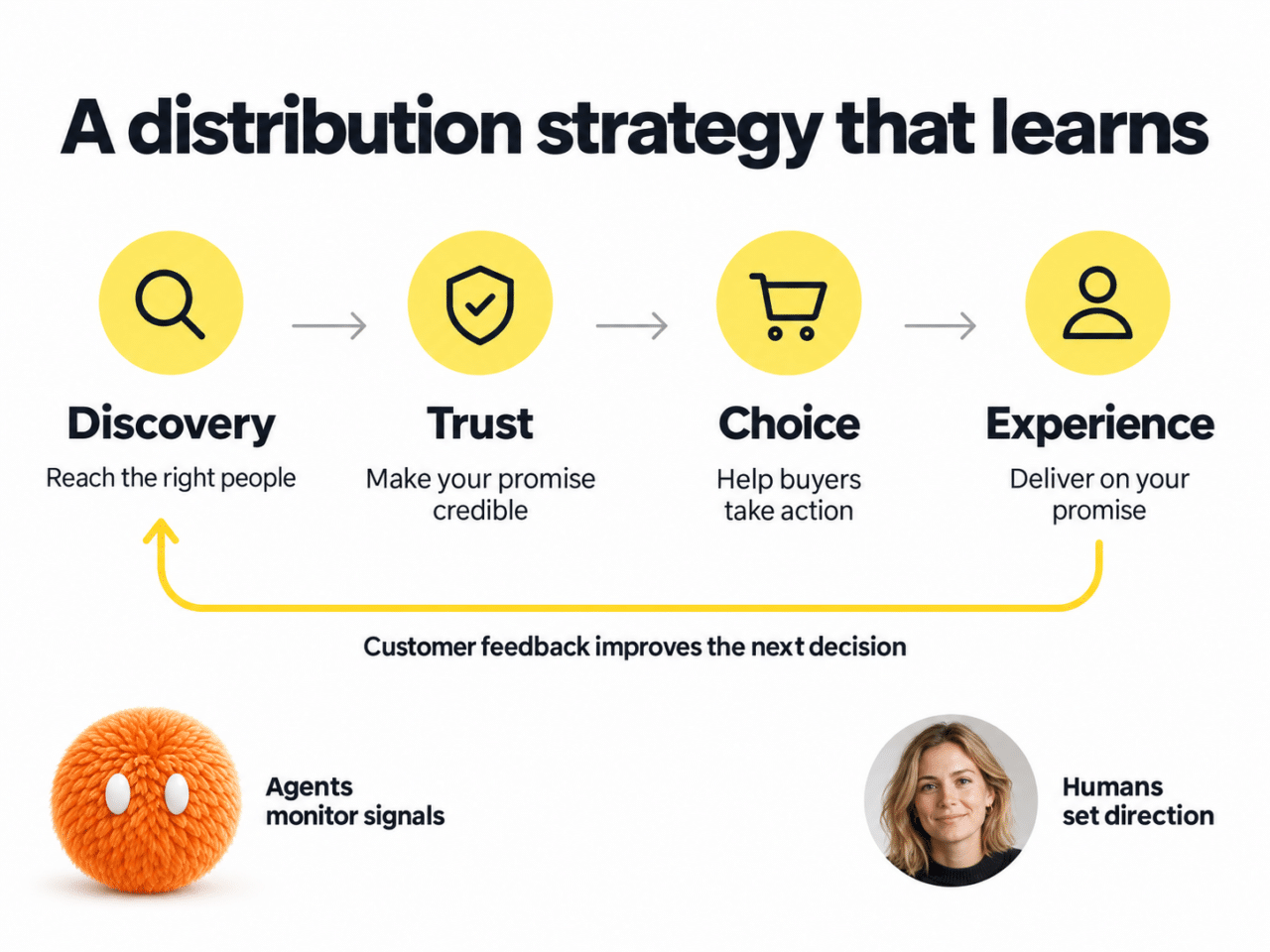
In this article, distribution means customer discovery and acquisition. It covers the work that makes a company easy to find, understand, trust and choose. Promotion is one part of that system, alongside follow-up and the experience after purchase.
For example, a large audience with weak follow-up is not strong distribution. An expensive ad campaign also struggles when the landing page makes the offer confusing. The parts need to reinforce one another.
01. Discovery
Reach the right people where they already look for answers. Search, useful content, creators, partnerships and communities can each provide a path.
02. Trust
Make the promise credible. Clear product facts, honest reviews, relevant demonstrations and real customer evidence help buyers judge the offer.
03. Choice
Help interested buyers act. Explain pricing and next steps, answer their questions, and respond while the need is still active.
04. Experience
Deliver what marketing promised. Then use customer results, feedback and objections to improve the product and the next campaign.
A good product remains essential. Distribution can help a customer choose once; the experience shapes whether they stay and recommend it. As a result, product quality and distribution need to improve together.
How AI changes product discovery
A buyer may form an opinion before visiting your website. For instance, they can ask an AI assistant to research a category, compare options and summarize reviews. Several alternatives may leave their shortlist before a company sees a website visit.
OpenAI’s shopping research experience explores products across the web and prepares buying guides. Likewise, Google’s AI Mode supports product exploration and comparison. These tools can make mistakes, so accurate information at the source still matters.
This does not make websites, advertising or content irrelevant. Instead, those assets may inform both the buyer and a system helping that buyer. Product pages, comparisons, reviews and expert coverage can all influence the information available.
Consequently, a distribution strategy cannot rely only on what website analytics can observe. Ask customers how they found you, review the questions they bring to sales, and compare those findings with referral and conversion data.
Build trust with people and clarity for AI
People and AI assistants may use the same information, but they do not assess it in the same way. A memorable story can make someone care. Meanwhile, clear facts help a system describe the offer accurately.
Give people a reason to care
Show that you understand a specific problem. Use a distinct point of view, thoughtful creative and relevant customer stories. Then support the promise with evidence the buyer can judge.
Give AI systems usable facts
Explain pricing, features, integrations and limitations clearly. Also keep product details consistent across your website and other channels. Accessible, accurate information reduces avoidable ambiguity.
For example, a project-management platform might tell a story about campaigns getting stuck between teams. That story gives a marketing leader a reason to remember it. However, an assistant comparing platforms also needs facts about pricing, permissions, integrations and security.
Google’s guidance for generative AI search emphasizes useful, distinctive content and sound technical SEO. It does not guarantee that a page will appear in an AI answer. Therefore, focus on clear information and real value rather than supposed visibility shortcuts.
A strong story with little evidence leaves buyers and assistants with unanswered questions. Conversely, a complete feature list without a clear point of view can make a product easy to compare but hard to remember. Your distribution strategy needs both.
Connect your marketing channels
Customers experience one company, even when several teams manage the journey. They might see a creator’s video, ask an AI assistant for a comparison, read reviews and speak to sales. Each encounter shapes their expectations of the same offer.
Inside the business, however, the learning often stays separate. Paid media knows which ads attract interest. Sales hears objections. Customer success sees whether the product delivers. When those teams fail to share what they learn, the gaps show up in the customer experience.
As a result, distribution improves through shared learning. What attracts attention should shape the website. What sales hears should improve the content. Finally, what customers experience should influence the next campaign.
Use AI agents to improve your distribution strategy
The same technology that increases marketing output can also help teams connect the signals. For example, an agent might identify a recurring sales question that the website never answers. It can then prepare the evidence for a person to review.
These workflows depend on approved data access, working integrations and clear ownership. Start with a useful recurring job, rather than assuming an agent can manage every channel.
Monitor changes that matter to acquisition
An agent can help compare ad performance with qualified leads and revenue. It might also flag unusual spending, a fall in landing-page conversion, or a lead source that needs review. However, conversion delays and tracking gaps can distort those signals.
Therefore, ask for the supporting data and uncertainty alongside any recommendation. The Company Brain role is useful here when it connects approved campaign, CRM and revenue information to customer acquisition decisions.
Bring customer insights back into marketing
Agents can group recurring questions from approved calls, reviews and messages. Next, they can prepare suggestions for content, product pages or campaign briefs. A person checks the interpretation before changing the promise.
Similarly, a reputation workflow can group new reviews and draft replies. Sensitive complaints still need an accountable owner. For outreach, an agent can research prospects and prepare context, while people decide whom to contact and why.
Keep actions within clear permissions
First, decide what the agent may read. Then define what it may do, what needs approval and who reviews the outcome. For example, flagging a budget problem is different from having permission to change spending.
A recurring role also needs a brief and success measures. Our guide to AI employees and digital workers explains those management requirements. For team responsibilities, see the AI marketing team structure.
What humans still need to own
More capacity makes direction more important. Someone still needs to choose the customer, understand the problem and decide which promise the business can keep. AI can support the work, but it does not remove responsibility for those choices.
In practice, people should own:
- Customer strategy: which needs to serve and which opportunities to decline.
- Creative judgment: which ideas deserve attention and how the brand should express them.
- Relationships: when a customer, creator or partner needs personal attention.
- Trade-offs: whether a short-term gain could weaken long-term trust.
- Accountability: who corrects mistakes and checks that delivery matches the promise.
For example, a campaign may improve click-through rate by making a stronger claim. However, that gain is not useful if the product cannot deliver. A human owner must judge the promise as well as the metric.
The aim of an AI-supported distribution strategy is to create more room for this work. Better monitoring should free marketers to talk to customers, develop ideas and build relationships that competitors cannot quickly copy.
Build your distribution strategy before launch
Many teams finish the product before working out how to reach customers. Yet AI can shorten the build cycle so much that the first version arrives before the team understands who cares or what proof they need.
Instead, develop the product and its distribution together. Use the following sequence to turn early learning into a reliable path to customers.
1. Talk to potential customers
First, learn how they describe the problem, what they have tried and what would make them act. Use those conversations to improve both the product and the language around it.
2. Explain what exists
Next, create a clear page showing who the product is for, what it does and what is available now. Add demonstrations and pilot results when they are real. Also make limitations and next steps easy to find.
3. Establish one reliable customer path
Choose one channel where likely buyers already look. Then connect discovery to a useful explanation, timely follow-up and a clear buying step. Learn what works before adding more channels.
4. Feed outcomes into the next decision
Finally, review qualified leads, customer questions, sales and retention alongside channel metrics. Use that evidence to improve the offer, the experience and the next campaign.
The hard questions remain: why should this product exist, who is it for, and why should someone trust it? A useful distribution strategy keeps those questions connected to daily marketing decisions.
AI gives companies more capacity to build. The advantage comes from turning that capacity into customer knowledge, stronger evidence and a system that learns. If your team needs support with ongoing marketing work, explore Nas AI agents and human specialists.
Frequently asked questions
Why does AI make distribution more valuable?
AI reduces the time needed to create products, websites and campaigns. As a result, customers face more choices and more marketing. Reaching the right people, earning trust and helping them choose become more valuable advantages.
What is a distribution strategy in the age of AI?
Here, it means a plan for helping customers discover, understand, trust and choose a business. It connects search, content, advertising, partnerships, follow-up and customer experience. It also uses feedback to improve the next decision.
Is distribution more important than the product?
No. A weak product can waste strong distribution by disappointing customers. However, a good product still needs a reliable way to reach people and explain its value. The product and the distribution strategy should improve together.
How does AI change content distribution?
AI can help create and adapt content for different channels. Meanwhile, AI assistants can use accessible content when answering buyers’ questions. Marketers therefore need useful, accurate material and a clear audience, rather than simply a higher publishing volume.
Can AI agents manage distribution?
Agents can support monitoring, research, analysis and approved routine actions. However, their scope depends on integrations, data quality and permissions. People still own customer strategy, creative judgment, relationships and important decisions.